

Paul and I hit a stretch a few years back where the most interesting thing we said to each other all day was a question about the water heater. Seventeen years married, two teenagers in the house, a standing Thursday night with the phones shut in a drawer, and still some weeks we sat on the back porch and ran out of things to say by 8:15. So I started buying games. Not the kind with a board and forty minutes of rules. The kind that fits on the kitchen table between two mugs. The Couples Game from DSS Games was the fourth one I brought home, and it is the only one still in the drawer by the couch instead of the bin in the garage.
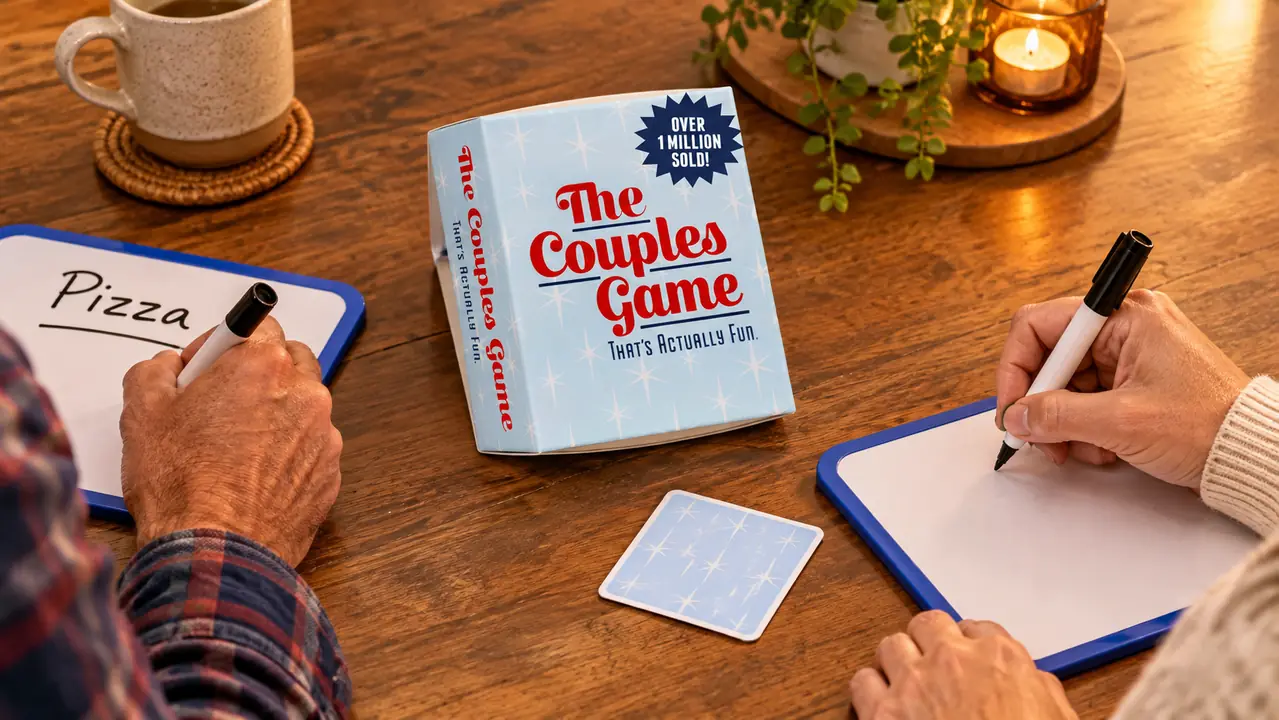
Here is the whole thing: 150 cards, three question categories, and two small dry-erase boards with pens so you write your answers instead of saying them out loud. No timer. No scoreboard. No app. You can play for twenty minutes or stretch it an hour. I have played it on a Thursday after the kids went to bed, on a Sunday afternoon with a daughter yelling at a video game in the next room, and once in a hotel outside Sandusky on our anniversary. What follows is what held up over about four months and what did not.
The Quick Verdict
Funny enough to keep in the drawer and sharp enough to surprise you, with a handful of cards that land like a pop quiz you did not study for.
Amazon Check Today's Price →The deck that got us talking past 8:15
150 cards across three categories, two dry-erase boards, two pens, and the cloths to wipe them. It all goes back in the tin, which is why ours lives on the coffee table instead of a shelf.
Amazon Check Today's Price on Amazon →How I've Used It
I tested it the way I test everything, which is without a plan. First night was a Thursday. Paul had come home from a long HVAC call, I had a stack of library returns to process, and neither of us had much to say. I put the tin on the table between the salt shaker and his iced tea and dealt a few cards from the Match stack. He is the quieter one in this marriage. He will answer a direct question, but he will not volunteer a paragraph. That is exactly the kind of person a board and a pen is built for, because writing an answer down gives him three seconds to think before he has to show it.
Something worth knowing: the boards change the tone. Answering out loud, especially for someone like Paul, invites a joke as a shield. Writing it down and flipping the board at the same time removes the escape hatch. You both commit, then you both look. A few times he wrote something and then tried to talk over it, and I just pointed at the board. That sounds like a small mechanic. It is the whole reason this deck works better than a list of questions read off a phone.
We have played it maybe nine or ten times now. Thursday nights, mostly, plus two Sunday afternoons when the weather was bad and one anniversary trip. Not every session is great. Two of them were flat, and I will get to why. But the average is high enough that the tin has not moved off the coffee table since February.
The night that sold me was not a good night going in. It was a Tuesday in March, Paul had spent nine hours on a rooftop unit, and I had spent the day refereeing a book fair. We ate leftover chili standing up. I pulled three cards from the Best stack because Best is the low-effort one, and by the time the bowls were in the sink we were both sitting down again and arguing, happily, about which of us would be worse at running a food truck. That is not a profound marital moment. It is the kind of hour we used to have all the time and had somehow stopped having.
What's Actually in the Tin
The DSS Games tin holds 150 cards on cardstock, two dry-erase boards, two dry-erase pens, and two small cleanup cloths. The cloths are the detail I did not expect to care about. Dry-erase smudges. Boards get wiped with a thumb and then the next answer shows a ghost of the last one, and there is a particular kind of awkward in watching your husband try to decode a ghost word. Use the cloths. The cards themselves are sturdy enough to survive a coffee table and a porch. The listing mentions the deck is handmade, and the tin has the slight irregularity to match. It is rated for ages 14 and up and built for two or more players, though I have only ever played it as a pair.
Everything fits back in the tin, which matters more than it sounds like it should. We own two other conversation decks that live in a rubber band because their boxes fell apart. This one closes. The pens are small and unremarkable, the kind that would dry out if you left the caps off, so cap them. I have not had one dry out yet.
The boards are small, and that is deliberate, because a small board forces a short answer. You cannot write a paragraph. You write six words and then you have to sit with them while the other person finishes theirs. Wiping between rounds takes three seconds if you use the cloth, and a little longer if you are the type to leave a ghost. Paul is the type to leave a ghost. I have made my peace with it.
The Three Categories, and Which One Carries the Night
There are three stacks: Match, Best, and Me or You. We start with Match because it eases you in. It is the low-stakes one, and on a first night it does most of the work of getting you both out of your own heads. Best is the one that produces the laughing. Some of the prompts are absurd enough that the answer you scrawl down is funnier than anything you would say out loud in a normal conversation.
Me or You is where the night gets interesting. It is the stack that assumes you know your partner, and then checks. Seventeen years in, I assumed I would crush it. I did not crush it. There were three in a row where I guessed wrong in a way that made Paul laugh until he had to take his glasses off, and one where he guessed wrong about me and then got quiet for a second, because he genuinely thought he knew and he did not. That is not a bad feeling. It is a useful one. We ended up talking about that single card for twenty minutes after the rest went back in the tin.
If you only have half an hour, pull from Me or You. If the mood in the room is already tense, pull from Match. If you want the night to feel like a date and not a conversation, pull from Best. That is the closest thing to a strategy I have after four months.
Seventeen years in, I assumed I would crush the Me or You stack. I got three wrong in a row, and then he got one wrong about me and went quiet, because he genuinely thought he knew.
What Fell Flat
Two things. First, some cards are spicier than a Thursday. I am not a prude and neither is Paul, but there are prompts in here I would rather not answer at 9 p.m. on a weeknight when I have to be at the middle school library at 7:15 the next morning. The deck does not label which is which, so you find out by flipping. Our fix is simple: read the card before you deal it. That removes the surprise, and it also removes a little of the fun, so we only do it for the ones we already know.
Second, the deck has a ceiling and you will hit it. 150 cards sounds like a lot until you have played ten nights. We have started skipping the ones we remember, and the pool of fresh cards shrinks every session. It is not a reason to leave it on a shelf. It is the reason this is a coffee table game and not a nightly ritual. We now play twice a month instead of every Thursday, and it is better that way. A deck that asks you to be honest works better when you have had a couple of weeks to accumulate something worth saying.
There is also a version of this that goes wrong and it is worth naming. If one of you is in a genuinely bad mood, the deck does not read the room. A prompt that would be funny on a Friday can land like an accusation on a Wednesday, and then you are having a different conversation than the one on the card. We have a rule now: if either of us says pass, the card goes back in the tin, no follow-up questions. Two passes in a row and we put the tin away and watch something. That rule has saved more nights than any card in the deck.

Does It Hold Up After the First Night?
Yes, with an adjustment. The first night is the best night, because every card is new and the surprise does the heavy lifting. After that, the deck relies on you. What surprised me is that the repeat plays are not worse, they are different. Once Paul knows the format, he stops treating it as a bit and starts giving real answers. The fifth night we had was better than the first one, and the reason was not the cards. It was that we had gotten used to the idea of writing something down and looking at each other while we did it.
So the honest answer to the title question is: it is fun the first night, and it is useful after that, and those are not the same thing. If you want a party trick, this is a good one. If you want a habit, this deck can start one, but the cards are not doing the work. You are. Paul put it well, which he does about once a month. He said it is like a crowbar for the door, and you still have to walk through it. None of that is a knock on DSS Games. It is closer to a compliment, because a deck that hands you the crowbar is doing its job.
One practical note on longevity: the cards hold up better than the boxes did on our other decks, and the tin still closes flush after four months of being carried between the kitchen and the porch. That is the least interesting thing in this review and it is the reason the thing is still in the room.
What I Liked
- The dry-erase boards change how the conversation goes, especially with a partner who deflects with jokes
- 150 cards across three categories, so you can match the stack to the mood in the room
- Everything packs back into the tin, which is more than I can say for the other decks we own
- The cleanup cloths are included and you will actually use them
- Rated for 14 and up and built for two or more players, so it stretches past date night
Where It Falls Short
- Some cards run spicier than a weeknight, and the deck does not tell you which
- The 150 card pool shrinks fast if you play weekly, and repeats get skipped
- The small dry-erase pens will dry out if you leave the caps off
- No labeling on the cards means the only way to sort by heat is to read them first
Who This Is For
Couples who have run out of small talk and are not interested in a lecture about it. If you are the talker and your partner is the one who answers in three words, this deck is built for that imbalance. It is also good for the stage after the kids get old enough to disappear into their rooms, when you look across the kitchen and realize you have not had a real conversation in a week. And it works as a gift, because it looks like a gift and it does not require the recipient to schedule anything. Anniversaries, weddings, the couple who says they do not need a game. Especially them.
Who Should Skip It
Skip it if you want a game with rules. There is no winning here, and if someone at your table needs a winner, this will frustrate them. Skip it if you are in a rough patch and looking for a deck to do the repair work. It is a conversation starter, not a counselor, and a card that asks a pointed question in the middle of a bad month can land badly. Skip it if you are shy about writing things down. And skip it if you want something for a crowd, since the two-board setup really does pull it toward pairs even though the box says two or more.
Ours has not moved off the coffee table since February
If you want the version of date night that does not require a reservation, start here. Read the spicy cards before you deal them, cap the pens, and give it a pass on the bad Wednesdays.
Amazon Check Today's Price on Amazon →