
Paul and I have been married for seventeen years, and somewhere around year twelve we stopped planning dates and started comparing errands. Thursday was our no phones night. It started a few years back, when we realized we had become two people who mostly discussed the dishwasher and the car. For a while the night worked. Then it turned into the two of us on opposite ends of the couch, each of us waiting for the other one to have an idea first.
That is what a date night rut looks like in our house. Not fighting. Not a cold marriage. Two people who genuinely like each other, sitting eight feet apart, out of things to say before nine o'clock. I would love to tell you I solved it with a sincere conversation. I solved it partly with a small box of scratch off date night cards from All Natural Shop that I set on the kitchen table next to the napkins, mostly because I was tired of being the only one with ideas.
The box held thirty five cards, two heart shaped coins for scratching, and a short instruction sheet. I expected a slightly awkward hour that at least counted as doing something. What we got was a Thursday where the conversation did not run out and nobody reached for a phone.
Thirty five dates already decided, sitting in a box on the counter
One deck, two scratching coins, one rule. Scratch a card with your partner tonight and skip the part where you both stare at each other waiting for somebody to invent a plan.
Amazon Check Today's Price on Amazon →Why Date Night Ruts Happen to Couples Who Like Each Other
Here is the thing I got wrong for years. I treated the rut as evidence of a problem. It was not. It was evidence of comfort and a full calendar. When the kids were small, we planned dates because we had to. Somebody had to line up a sitter and a restaurant and a reason to leave the house. Now our son is sixteen and our daughter is fourteen, and they go to bed early enough that we have the evening to ourselves, which means nobody schedules anything, because in theory we already have all the time in the world.
In theory is where date night goes to die. A rut is not a feeling. It is a missing decision. Once I understood that, the fix got a lot less romantic and a lot more doable. We did not need to fall in love again. We needed something in the house that made the decision for us, at nine at night, when neither of us wanted to be the one to invent an evening.
What Is Actually in the Box
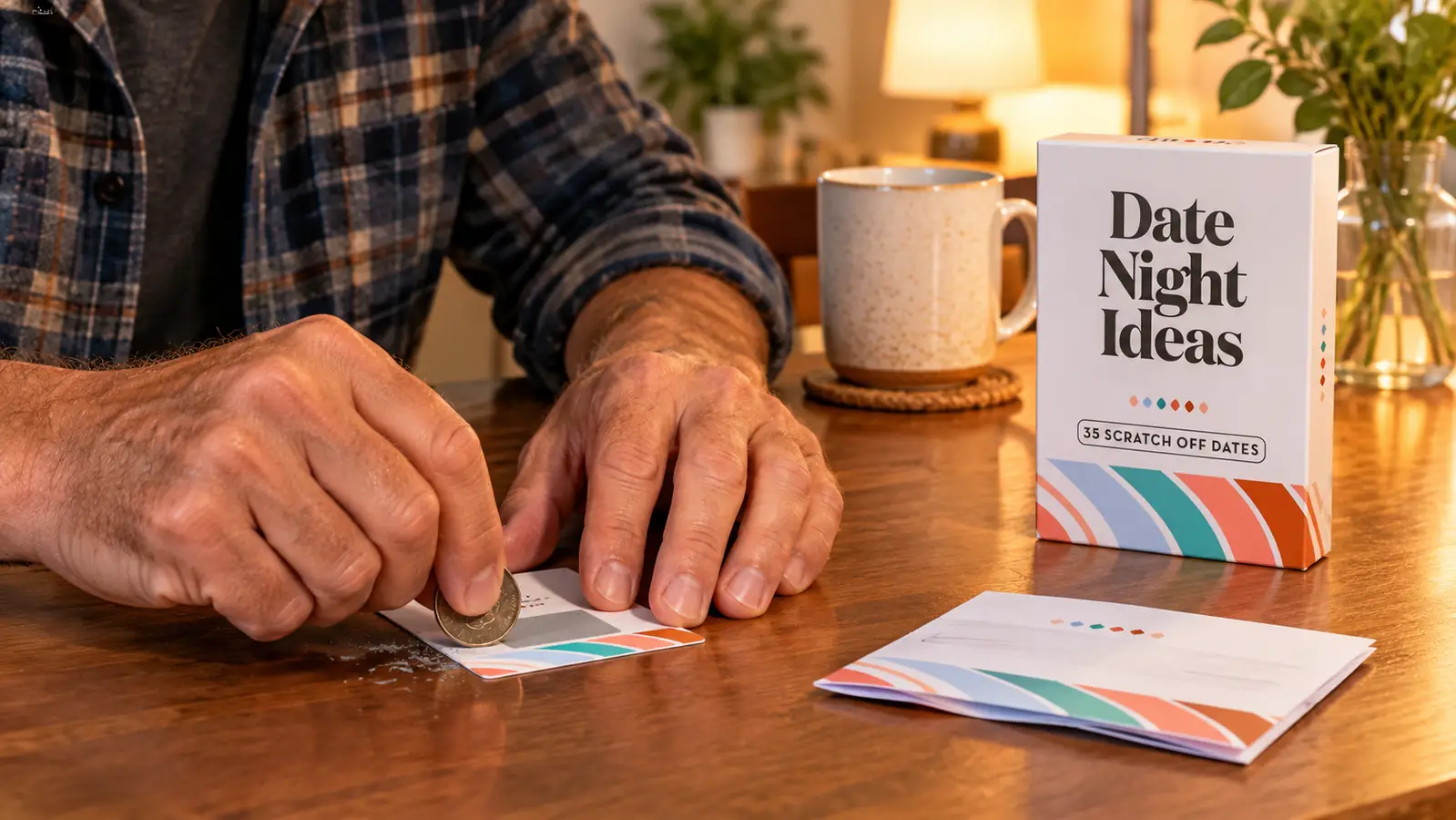
The All Natural Shop deck is thirty five scratch off cards in a small box, plus two heart shaped coins and a page of instructions. The cards are cardstock, the set is made for two players, and the box is labeled for ages sixteen and up, which suits a house with two teenagers who are not invited to this particular activity. It weighs under six ounces, so it lives in the drawer by the napkins and comes out on Thursdays.
The design detail that matters is that each card carries a few clues about where the date happens, at home or out, before you scratch it. That is the difference between a deck you use and a deck that annoys you, because you are not accidentally committing to an evening out on a Wednesday with no warning. You read the clues, you agree on a card, and then you scratch.
Step 1: Say the Rut Out Loud Without Making It a Complaint
The first step is the one most couples skip. Say it plainly, to the other person, in a normal voice. Not we never do anything anymore, which is an accusation wearing a cardigan. Try something closer to: I miss having something to look forward to with you on a Thursday.
I said some version of that on a Saturday morning, standing at the counter, and Paul's answer was okay, so plan something, which is very much Paul and also the exact answer that had stalled us for months. So we changed the arrangement. Neither of us would plan the next one. We would get something we could both pick from, so planning stopped being a chore that landed on whoever felt guiltier that week.
That is the whole point of a deck like this one. It takes the planning job away from both of you and puts it in a box. You do not have to be creative at nine at night. You read a clue, you pick a card, you scratch it.
Step 2: Pick One Night and Make It Boringly Fixed
Vague intentions do not survive teenagers, overtime, and a sink full of dishes. Pick a night, put it in your phone, and tell the kids it exists so they stop wandering out to ask about laundry. Ours is Thursday, and it moved from the couch to the back porch as soon as the weather allowed, partly because a change of room makes the evening feel like an event and partly because Paul will talk more outside.
Then protect the night from the thing that always eats it, which is phones. Our rule is that phones go in a kitchen drawer, out of the room. Not silent. Out of the room. If one of us has a work thing that genuinely cannot wait, we say so at dinner and the night moves to Friday. No drama, no scoring, no tally of who cancelled last.
The point is not that Thursday must be sacred. The point is that Thursday must be decided. A night that gets rescheduled is still a night. A night that never gets named is a feeling that slowly curdles.
Six weeks in, we had a stack of scratched cards and a story from a job Paul held at twenty-four that I had never heard in seventeen years of marriage.
Step 3: Let the Card Choose Instead of Choosing Each Other
This is where the deck earns its place on the table. You read the clues, you pick a card together, you scratch it with one of the two coins, and you do the thing on it. Nobody has to pitch an idea. Nobody has to sell an idea. The card belongs to the box.
The reason that works is not mysterious. It removes the negotiation. When I ask Paul what he wants to do, he says I don't care, and he means it, and then whatever I pick becomes my idea and my responsibility and quietly my fault if it is dull. A card is nobody's idea. That sounds like a small thing. It changed the entire mood of the evening for us.
There is a second effect, and it surprised me. Cards suggest things you would not have proposed, and because the suggestion came from a card rather than a spouse, it is much easier to say yes to. I have agreed to things from that deck that I would have laughed at if Paul had raised them over dinner. He has done the same. After seventeen years, that is worth more than it sounds.
Step 4: Keep the One Rule and Add Two of Your Own
The box comes with one rule, and the cards carry the clues. Our house rules are two. The first is no vetoing before you scratch. You can pass on the top card, but passing means you take the next one, no digging around for the card that sounds easiest. The second is a skip pile kept in the lid, for anything that needs money we do not want to spend or a sitter we do not have on a school night.
That second rule matters more than it sounds. Any set of date ideas includes a few that assume a whole weekend. If you do not give yourself permission to skip, you end up not playing at all, and the deck goes in a drawer next to the takeout menus. Permission up front keeps the whole thing usable.
The other rule I would add, if you are married to the quieter half of the pair, is a this or that rule. If a card is too open ended, you do not have to answer it cold. Offer two options and let the other person choose. Paul will talk for an hour once he has something to push against. He will not talk for five minutes into a wide open question.
Step 5: Write Down What Landed and Then Do It Again
Keep the scratched cards. Not for sentiment, for data. On the back of the ones that worked, I write a date and two or three words. Porch, the one about the old job. Kitchen, the questions one. Six weeks in, you have an honest record of what the two of you actually enjoy, which is information most couples do not have, because we all rely on memory and memory is generous and vague.
Then repeat. This is where most decks get abandoned, because people chase a brand new experience every week and burn out by March. Novelty is not the goal. Connection is the goal. Some of our best Thursdays have been repeats, and I stopped worrying about whether repeating a card counted as cheating.
If you work through all thirty five, resist the urge to buy a second deck right away. Go back to the repeat pile first. The deck is a starter, not a subscription.

What Else Helps
A deck is a tool, not a cure. A few other things have done real work in our house. Food helps, and it does not need to be a meal. A plate of something on the porch counts, and it gives your hands something to do when the conversation hits a lull. Twenty minutes is enough to count as a date, which is worth saying out loud to anyone who thinks a date requires a whole evening and a reservation.
It helps to alternate who scratches, because whoever holds the card holds the moment. It helps to keep the box somewhere visible rather than in a closet, since a deck you cannot see is a deck you will not use. And it helps to say out loud when a card falls flat. Two of ours did, both of them the kind that assumes you want to be silly on a Tuesday. We laughed, we skipped them, and we did not conclude anything about our marriage. That is the right response to a card that misses.
One more thing, and I mean it. If your Thursday nights have gone quiet for reasons bigger than scheduling, a card deck is not the fix. It is a pleasant way to spend an hour with someone you like. If the silence is heavy and has been heavy for a long time, the deck can sit on the table while you have the harder conversation, or while you find someone who can help you have it. Cards are a door. They are not the room.
Thirty five Thursdays before you have to think of anything yourself
The All Natural Shop deck is one box, two scratching coins, and a rule short enough to read out loud. Put it on the counter, pick a card with your partner, and let the evening start itself.
Amazon Check Today's Price on Amazon →