
The first thing I did when the tin from DSS Games landed on my kitchen table was flip through looking for the cards that would make my husband Paul blush. There are none. That single fact tells you more about The Couples Game That's Actually Fun than any product photo does. It is a conversation deck built for warm, low-stakes talk between two people who already know each other, not a truth-or-dare situation that ends with somebody sleeping on the couch. Whether that is exactly what you were hoping to buy or a mild letdown depends entirely on which person you are. This review is written for the second group as much as the first.
I have been testing this deck on and off for a while now, mostly on Thursday nights after the kids go to bed. That is our standing no-phones night, the one we started a few years back when Paul and I realized we had gone three days without a conversation that was not about the water heater or a school form. He is quieter than I am. I am a middle school librarian, so I talk for a living. He troubleshoots furnaces all day and would honestly rather listen. A game that gives him a reason to answer a question is worth more to us than one that entertains me for twenty minutes. So I am grading this deck partly on whether it got him talking.
The Quick Verdict
A warm, low-pressure prompt deck that gets a quiet partner talking. Not spicy, not deep, and the components are the weakest part. Best used as a twenty-minute warm-up, not as the whole night.
Amazon Check Today's Price →The date night that does not need a babysitter or a reservation
150 cards across three categories, two dry-erase boards, two pens and two cloths, all in one tin. Sit down, write an answer, find out what your partner actually thinks.
Amazon Check Today's Price on Amazon →What Nobody Tells You Before You Buy
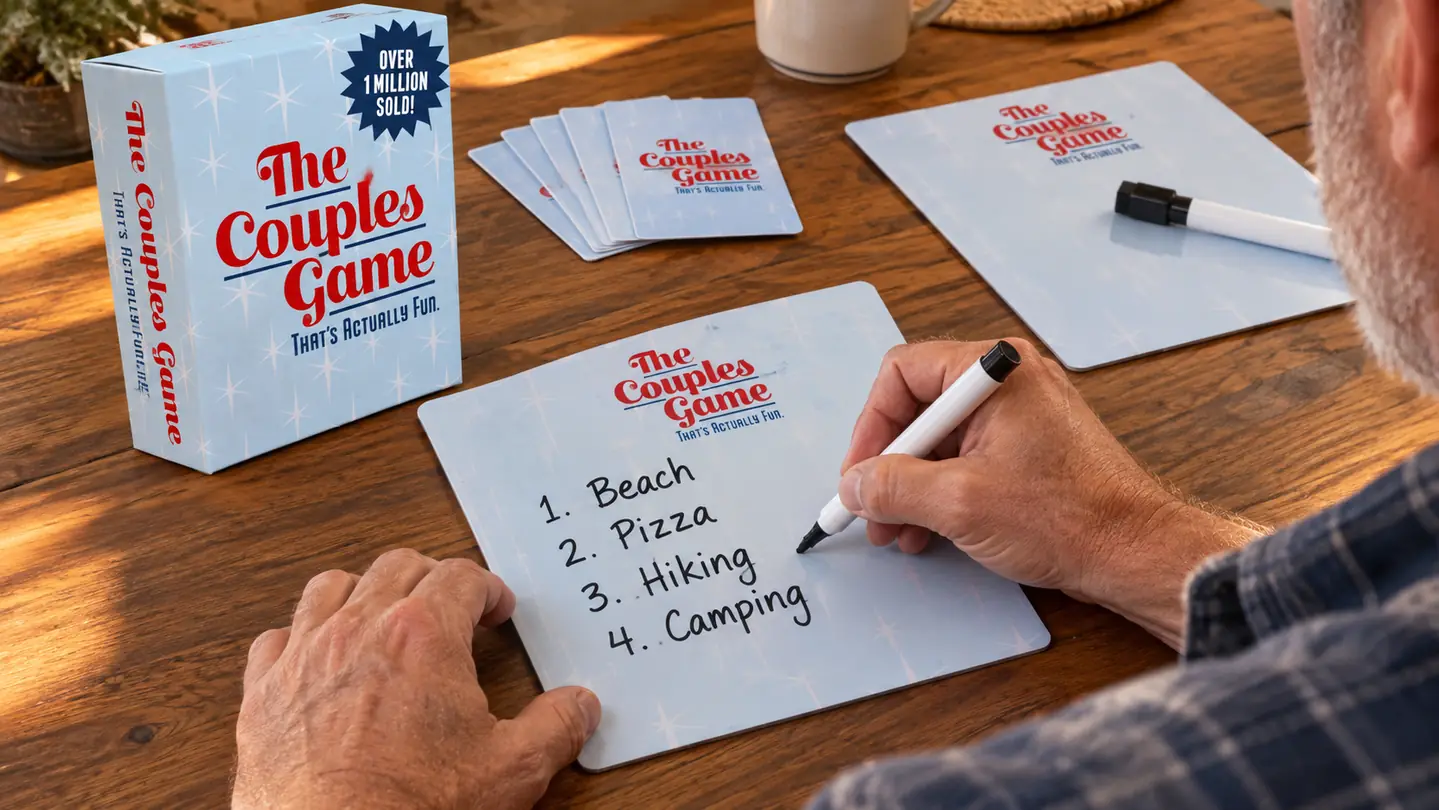
The dry-erase boards are the actual product. The cards are just prompts. That sounds obvious until you sit down and realize every single round involves writing an answer down, comparing it to your partner's, and wiping the board clean for the next one. There are two boards, two pens and two small cloths in the tin, which is the right call, because one board between two people would turn every round into a negotiation about who writes first. If you are the sort of person who hates being put on the spot to produce an answer on the spot, this format will feel like a pop quiz on night one.
150 cards is a real number until it isn't. Counting all three categories, you will move through a decent stack in a single sitting, and by the fourth or fifth time you play you will start recognizing prompts. Not the exact wording every time, but the shape of them. The deck does not have the depth of something you can play weekly for a year without noticing the seams. It has the depth of something you pull out once a month, or when friends are over, or when a road trip needs a distraction that is not a screen.
The age rating is 14 and up, and that is not a formality. Some of the questions invite you to describe your partner's habits and preferences, and the answers get personal in a friendly way. Nothing here is explicit. But nothing here is designed for a table with young kids at it either, and I would not hand it to a couple on their second date. The listing also points to two other DSS Games titles, Who's Most Likely To and You Laugh You're Out, which tells you what kind of company this deck keeps. Party games with a soft edge.
How the Three Categories Actually Play
Match is where the deck earns its keep. Both of you answer the same question without showing each other, then reveal. The pleasure is not in being right. It is in the gap between what you assumed and what your partner actually said. Paul and I had a run of three in a row where we were completely aligned on the small stuff and wildly off on the bigger stuff, and that mismatch started a conversation that outlasted the rest of the game. If you only ever use one category, use this one.
Best is the lighter category, closer to a party game. You get a prompt that invites an opinion rather than a memory, and the fun is in defending a ridiculous answer. This is the one that gets the most laughing and the least depth. It is also the one that works best with another couple at the table, because more answers mean more material to bat around.
Me or You is the guessing category, and it is the one that surprised me. It asks you to say which of the two of you a statement fits better. Paul is not a man who volunteers self-descriptions, and this format lets him answer without feeling like he is giving a speech. That is the specific mechanical thing this deck does well. It turns a question into a fill-in-the-blank, and a fill-in-the-blank is much easier to answer than an open question.
Two players is the sweet spot. The box says 2 or more and that is technically true, but with four people the writing and wiping gets slow, and one quiet person at the table can end up spectating instead of playing. My honest advice is to keep it to the two of you and treat the group version as a bonus rather than the reason to buy.
A card is easier to say yes to than a question. 'Do you want to talk about us' is heavy. 'Do you want to do ten minutes of the card game' is not.
Where It Fell Flat at My Kitchen Table
The pens. I am going to be the person who complains about the pens. Dry-erase markers in a game tin are never going to be great, and these are small and fine-tipped, which means your handwriting gets cramped after a few rounds and one of the two started skipping for us within a month. You can swap in your own markers and you probably will. It is a small thing that does not ruin a night, but it does mean the components are the least impressive part of the package.
One more mechanical note, because this is the honest version of this review and mechanical notes are what people actually come for. The boards are small, and if you write large you will fill one up in a single answer. Paul writes small and neat, because he labels equipment for a living. I write like a librarian taking notes in a hurry, which is to say large and slanted. By round six I was squeezing onto two lines and squinting. Not a deal breaker. Worth knowing before you buy.
Some prompts landed with a thud. There is a stretch in the Best category where the questions are so broad that the answers stop being interesting by the third round, and Paul started giving joke answers just to move things along. He does that when he is bored and I can always tell. A deck this size will always have dead cards. The issue is that the dead ones cluster, so a night can sag in the middle before it picks back up.
It does not fix anything. I want to be clear about this because the marketing around conversation decks can get airy. This is a set of prompts in a tin. It gave us a better Thursday night. It did not make us better at conflict, and it did not surface anything we had been avoiding for seventeen years. The couples who get the most out of it are the ones who were already fine and wanted a reason to sit still together for an hour.
The cloths are smaller than you want them to be. That is the whole complaint. Two cloths, both little, both doing a lot of work by round ten. If you are wiping a board after every single answer, which you are, they wear out faster than the pens do. Buy a pack of cheap microfiber cloths and leave them in the tin. That is the entire life upgrade.
What I Liked
- No setup and no rules to learn, so it gets played instead of shelved
- The Match category produced genuinely new information about a person I have lived with for seventeen years
- The writing format gives a quiet partner an easy way in
- 150 cards, two boards, two pens and two cloths, all kept together in one tin
- Works as an anniversary or wedding gift for people who are not board game people
Where It Falls Short
- The included pens are small, fine-tipped, and one started skipping within a month
- The cloths are undersized for the amount of wiping the game requires
- You will start recognizing prompts after four or five sessions
- The Best category sags in the middle of a night
- No winner, no score, no structure, which some people genuinely hate
- Not spicy, not deep, and it will not fix a rough patch
What Actually Changed After a Few Months
The deck found a permanent home on the shelf next to the kitchen table, which is more than I can say for most of what I test. But it is not the main event anymore. It became a warm-up. We play three or four cards while dinner is finishing, then put it away and talk about whatever the cards stirred up. That turns out to be a better use of it than a full game night, because the prompts get the conversation moving and then the conversation takes over. The deck is a starter, not the meal.
The other thing that changed is that Paul started reaching for it. That surprised me. He is the one who usually needs a reason to open up, and after a few weeks he was the one pulling the tin off the shelf on a Thursday. I do not think the cards are magic. I think a card is easier to say yes to than a question. 'Do you want to talk about us' is heavy. 'Do you want to do ten minutes of the card game' is not.
Here is the part I did not expect. The questions stay with you after the tin closes. Paul answered one Match prompt in a way I did not predict, and I thought about it for two days. That is not a feature you can print on a box and it is not universal, but it is the reason I keep this deck on the shelf instead of in the drawer with the rest of the things I tested and forgot.
What I Would Change
More cards, or fewer repeated structures. If DSS Games ever does a second edition, I would want more prompts in the Match category and a thinner Best stack. I would also want full-size pens and cloths twice the size, which is a boring note but it is the note I keep coming back to. The tin itself is sturdy and holds everything, which matters more than it sounds like it does, because a game that lives in a flimsy box ends up in a drawer.
I would also drop the 2-or-more framing and be honest about the design intent. This is a two-person deck with a group mode, and the group mode is fine but it is not the reason to buy. Every couple I have handed it to has played it as a two-person thing, including the pair who bought it specifically for game night with friends.
The tin holds everything, which sounds like a low bar and is not. Cards, two boards, two pens, two cloths, all in one container that closes. Every card game I have owned that came in a tuck box ended up with its pieces scattered across a drawer within a month. This one has stayed together, and staying together is why it gets used.
Who This Is For
Couples who like each other and have gotten a little boring about it. That is the honest target. You have a routine, you have logistics, you have seventeen years of shared admin, and somewhere in there the two of you stopped asking each other anything that was not a yes or no. This deck is a low-effort way to put a question back on the table. It works especially well for the pairing where one person talks more than the other, because the writing format evens that out. It is also the DSS Games title I hand to people most often when they ask what to buy for an anniversary, since it does not require the recipients to be board game people.
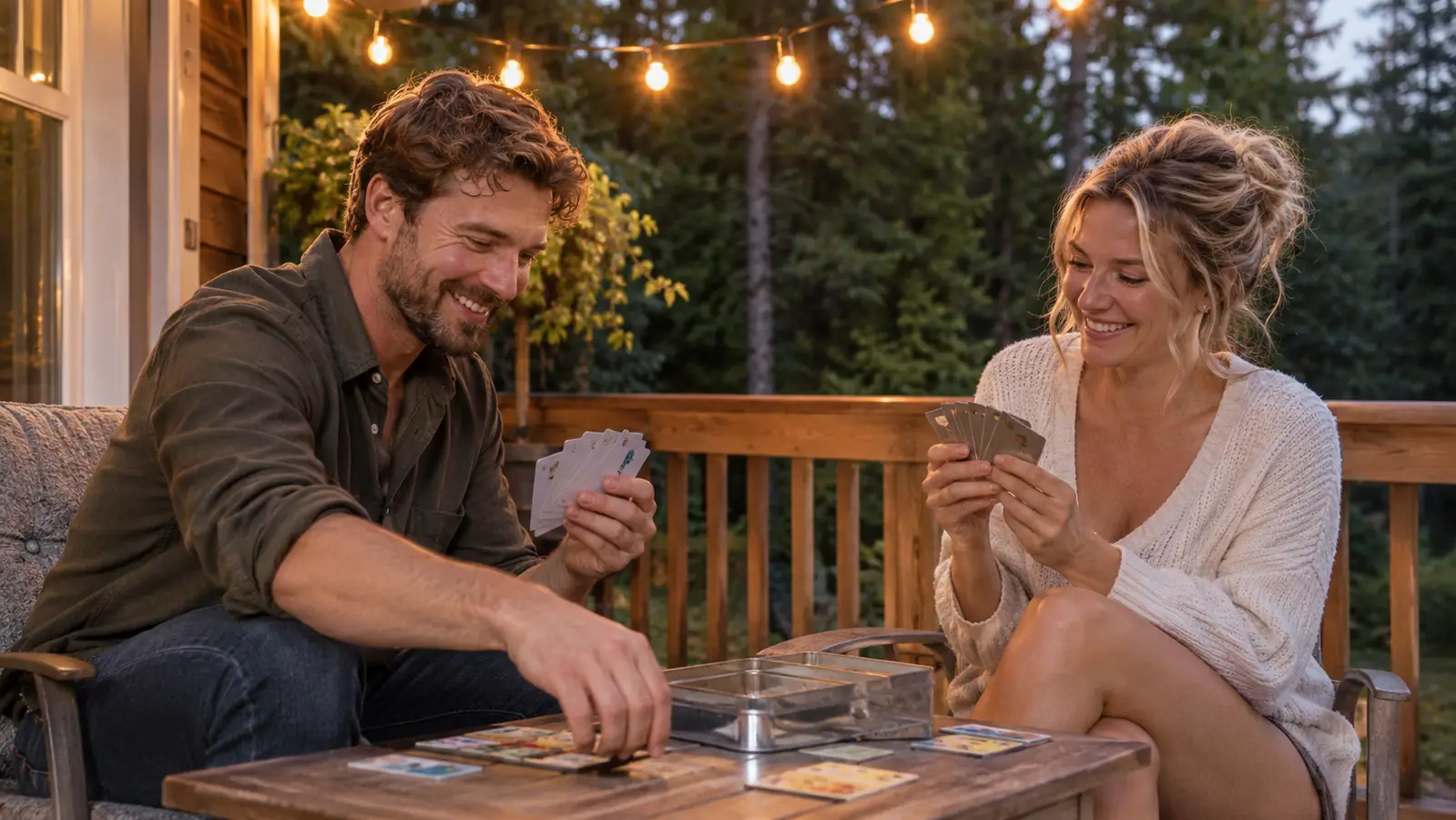
We did try it with another couple on the porch in September. It went fine. Not great, fine. The four of us worked through maybe a dozen cards, the laughing was real, and then the two of them started talking about their kitchen renovation and the deck went back in the tin. That is the whole group-play story. It is a good icebreaker for a table that has run out of things to say and a mediocre main event for a table that has not.
Who Should Skip It
If you want a game with a winner, skip it. Nobody wins. There is no score, no finish line, no reason to play a second round other than wanting to. People who need structure will find that frustrating. If you are looking for something to heat up a date night, skip it too, because this deck is warm rather than spicy and it will not get you there. And if the two of you are in a rough patch, do not buy a card game and call it work. Get real help. A tin of prompts is not a substitute for that, and pretending otherwise is how people end up disappointed in a product that never claimed to do it.
Skip it as well if you are the couple who already has long, easy conversations every night. You will not get much out of prompts you could have come up with yourself, and you will be paying for a tin to hold them. This deck is a tool for people who need the nudge, not a reward for people who never needed one.
If your Thursday nights have gone quiet, start here
Three categories, one tin, no rules to learn. Ten minutes on the couch is enough to find out something you did not know about the person next to you.
Amazon Check Today's Price on Amazon →