

The deck arrived in March. Paul had been on a furnace install all day and I had spent seven hours telling eighth graders to put their phones away, so neither of us was what you would call sparkling company. I set the small pack on the kitchen table, and he looked at it the way he looks at a restaurant menu in a language he doesn't speak. Then he pulled out a chair.
That is the honest reason I ordered ESTHER PEREL Where Should We Begin. Not because our marriage was in trouble. Because we had become very good at logistics and very bad at talking. Seventeen years in, two teenagers, a Thursday no-phones night that had quietly turned into a show we both half watched. I wanted something that made a person say the second thing, not the first. This is what six months with that deck actually looked like in our house.
The Quick Verdict
A genuinely good conversation deck for couples who already trust each other and need a reason to go deeper. It earns its keep on Thursday nights. It is not a rescue tool, and it will not carry a reluctant partner on its own. A strong, well-made conversation deck for established couples. Best used regularly in short bursts, not as a one-off novelty.
Amazon Check Today's Price →The deck that made my quiet husband say the second thing
ESTHER PEREL Where Should We Begin is a small pack of cards and dice built for exactly the table we were sitting at. If your Thursday nights have turned into mediocre television, this is a two-minute way to change the subject.
Amazon Check Today's Price on Amazon →How I've Used It
I want to be specific about method, because I think most of the bad experiences people report come from how they use a deck, not from the deck. We played at the kitchen table, after the kids went to bed, usually around nine. Never a whole evening. Forty minutes, sometimes twenty. We kept it on the table between Thursdays so it wasn't an event we had to schedule, just a thing that was already out.
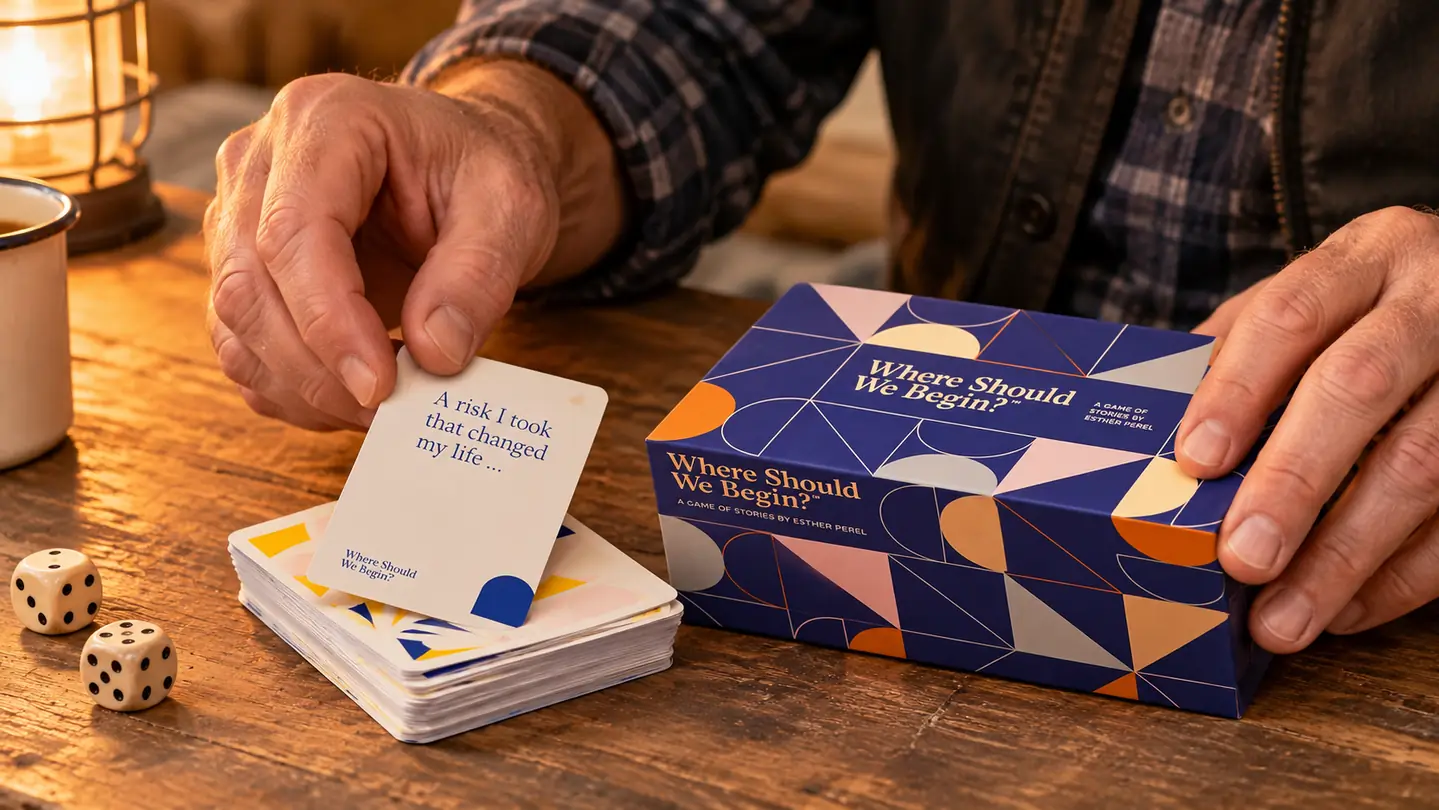
The box holds cards and two dice, and it's about the size of a paperback, six and a half inches by three and a half. It lives in the drawer with the takeout menus. The cards are cardstock with a decent weight to them, not flimsy, and the second edition box is small enough that I've thrown it in a tote for a weekend at my sister's. That sounds like a small thing. It matters more than you would think. A game that lives on a shelf in another room does not get played.
The dice decide the category and the depth. That's the whole mechanism, and it's a good one, because neither of us has to choose how hard to go. I can blame the die. If a question lands wrong, we can roll again without anyone having to say they don't want to answer. In a marriage, that little bit of cover is worth more than the deck itself.
The listing says up to six players and ages twenty and up. We have only ever used it with two, and that is the version I can speak to honestly. I also brought it to my sister's house in June and played with three, and it held up, though three people means each round is slower and the deck's pace suffers. It is really at its best with two people who live together.
Where the Deck Actually Shines
The prompts are the reason this thing works, and I'll tell you why they work on me when so many other conversation decks don't. Most of them ask you to evaluate. Rate your week. Name three things you appreciate. Those are fine. They are also the questions you can answer without opening the drawer.
The ESTHER PEREL deck asks for a story instead. It sets a scene and asks what you did, who you were then, what you remember. Because it wants a memory rather than an assessment, you can't answer it in a sentence. Paul, who will answer "fine" to almost any direct question about feelings, gave me a fifteen minute answer about his father's garage one night. I had never heard that version of the story. We've been married seventeen years.
There is a pattern the deck keeps coming back to, and it is the one I've come to admire most: the idea that you are not one couple, you are several. The people you were when you met, the people who had toddlers, the people in the house this year. It asks you to look at the earlier versions of a person you see every day. That reframe is blunt and practical and it worked on me every time.
Paul gave me a fifteen minute answer about his father's garage one night. I had never heard that version of the story. We've been married seventeen years.
The other thing this deck gets right is that it doesn't flinch from the fact that two people who love each other can still hurt each other and still be tired of each other. There's warmth in it, but there is no saccharine. If you are looking for a deck that will make you feel fond, this is not quite that deck. It's better, but it's not that.
What It's Actually Like Over Six Months
Month one was the fun part. We played three times in the first ten days, which is a good sign for a new purchase and a bad sign for a habit. By the end of April we had settled into Thursdays, and it stopped feeling like an experiment and started feeling like furniture. That is the highest compliment I can pay a game.
Month two and three were the interesting ones, because you start hitting repeat territory. There are enough cards that we still get fresh prompts, but I recognized a few favorites and steered toward them. That's on us, not the deck. The die mixes it up if you let it. I will say plainly that a couple who plays daily will run through the depth in a few weeks. This is a weekly rhythm, not a nightly one.
Somewhere in the middle there was a night I didn't want to play. It had been a bad week, work and a car and the kids, and I did not want to open up. I said so. Paul laughed and said we could roll again. That night we got about four cards in and quit early and ate leftover cake. That is also part of the honest review. The deck is not a railroad. You can stop.
By the fall, the thing I noticed was less about the game and more about the rest of the week. There were small references, an inside comment on a Tuesday, a callback to something said at the table. That's the actual product. The cards are just the excuse.
Where It Gets Uncomfortable, and That's the Point
I need to be clear about this part, because if you go in expecting a light party game you will get ambushed by a card. Some of these prompts ask about unfinished business. Some ask what you wished had been different. This is not a deck of cute questions, and the age floor of twenty years and up is not decoration.
The first time one of those landed, Paul got very still. Then he answered, and I answered, and we were both a little raw for an hour. It was not a fight. It was not a breakthrough. It was a Tuesday night that got heavier than we expected. I went to bed holding onto a sentence he said for the next two days.
My honest advice: do not open this on a first date, a wedding weekend, or a night when either of you is already upset. It's not built for that. It's built for a night with a little slack in it. If you are in the middle of something hard, this deck can touch it, and that is a volume knob a couple should be able to control. I'd rather tell you that plainly than have you find out.

The Physical Details and the Small Frictions
The box holds up. Six months of Thursday nights and the lid is snug and the corners are intact. The cardstock is fine, matte finish, easy to shuffle or, in our case, easy to spread face down and poke through. Dimensions run about six and a half by three and a half inches, so it takes up almost nothing on a table and fits in a drawer.
My gripes are small but real. The print on some cards is smaller than I'd like in low lamp light, which is when we play. There's no reference card or short instruction sheet tucked in, so the first night we spent a few minutes guessing at the rules before deciding on our own version, which I suspect is what everybody does. And the categories overlap more than the die implies, so rolling again usually gets something adjacent rather than something new.
None of those would stop me buying it. Together they explain why this is a very good game and not a perfect one, and why I'm giving it an honest eight and a half rather than a nine.
What I Liked
- Prompts ask for stories rather than self-assessments, so quiet partners actually talk
- Small box that lives in a drawer, which is the reason we kept playing
- Dice let you blame the game for going deep, which lowers the temperature
- Sturdy cardstock and a lid that still fits after six months
- Works well for a weekly twenty to forty minute rhythm
Where It Falls Short
- Cards get heavy without warning, and there is no way to see it coming
- Print is small in dim lamp light
- No instruction card in the box
- A couple who plays often will run out of fresh ground in a few weeks
Who This Is For
If you have been together long enough that you can run a household on a schedule and a group text, and you have noticed that the interesting conversations stopped somewhere around the second kid, this deck is for you. That is exactly the gap it fills. It doesn't create affection. It gives two people who already like each other something to do besides watch a show and something to say besides the schedule.
It is also genuinely good for a partner who is quieter than you are. Paul would rather do almost anything than answer "how are you feeling." He will answer a story prompt, because it has a shape and a boundary. If you are the partner who does most of the talking in your house, the die will help you stop.
I'd also hand it to a couple who is fine but bored. Not in crisis. Bored. That is a bigger category of marriage than anyone admits and there is not much on the market aimed at it. ESTHER PEREL built something for that middle, and it shows.
Who Should Skip It
Skip it if your relationship is in the middle of something you have not dealt with and you are looking for cards to do the work. They won't. A deck can open a door and it can absolutely open a door you were not ready for, and that is not a good trade. Get a counselor, then get the deck as a maintenance habit later.
Skip it if your partner has told you in plain words that they do not want to do this. I have watched couples try to game away a reluctance and it goes badly every time. The deck is not persuasive. It's a tool for people who both already agreed to sit down.
Skip it if you wanted a party game. Despite the listing's dating and game night framing, this is not a thing you put out with another couple over drinks unless everyone is very comfortable and you've read the room. It gets personal fast. Some nights that is exactly right. On a Saturday with friends, it usually isn't.
And skip it if the two of you are looking for a one-time fix. There is no such thing here. The value is in the rhythm, in the twenty minutes on a Thursday, in the fact that the box is already on the table. Bought and played once, it's a novelty. Kept on a drawer and pulled out every week, it changes the texture of a household. Give it a few weeks of short sessions before you decide whether it belongs on your own table.
Twenty minutes on a Thursday is the whole trick
ESTHER PEREL Where Should We Begin is the deck that got my husband talking about his father's garage after seventeen years. It won't fix anything. It will give you something to say besides the schedule.
Amazon Check Today's Price on Amazon →