

I own two decks of conversation cards and I have used both on the same husband. That is the whole test. Paul is forty eight, he repairs furnaces for a living, and he is the kind of man who will summarize an entire day with the word fine. A few years back we started a no phones Thursday because we had drifted into being very good roommates who split the grocery list. So when a deck of cards promises it will get two long married people talking again, I am the audience and I am also the skeptic.
Here is the short answer. If you want depth, stories, dice and a game that can stretch to a table of friends, buy ESTHER PEREL Where Should We Begin?. If you want a plain, structured set of questions built for exactly two people, sorted into categories so you can pick a lane on a random Tuesday, the BestSelf Relationship Deck is the gentler place to start. Both decks got us talking. They got us talking in completely different ways, and only one of them earned a permanent spot on the counter next to the coffee maker.
| ESTHER PEREL Where Should We Begin? | BestSelf Relationship Deck | |
|---|---|---|
| What it is | A conversation card game with storytelling prompts, plus dice, sold for dating and game night | A deck of question cards for couples, sorted into themed categories |
| Players | Listing says six players, so it works for a couple or a group | Built for two, nothing to adapt |
| Prompt style | Open-ended storytelling prompts, room for an answer to become a story | Direct questions you can answer in a sentence or two |
| Ease for a reluctant partner | A wide open prompt can stall someone who answers in one line | Categorized questions give a quiet partner an easy first answer |
| Components | Cards and dice, cardstock, manual play, pack measures about 6.6 by 3.5 by 4 inches | Cards |
| Group play | Scales to friends at the table, listed for six players | A two person deck, not built for a crowd |
| Repeat play | 2nd edition added new prompts and redesigned cards on top of the original set | You work through the categories you like and skip the rest |
| Best for | Couples who want a story, plus the occasional game night | Couples who want a structured ten minute check in |
One note on reading that table. The BestSelf Relationship Deck is not a worse product, it is a narrower one. It does one job and does it without fuss. The ESTHER PEREL game does several jobs and asks more of you in the process, which is either the appeal or the reason it ends up back in the box after two weeks.
What Each One Actually Is
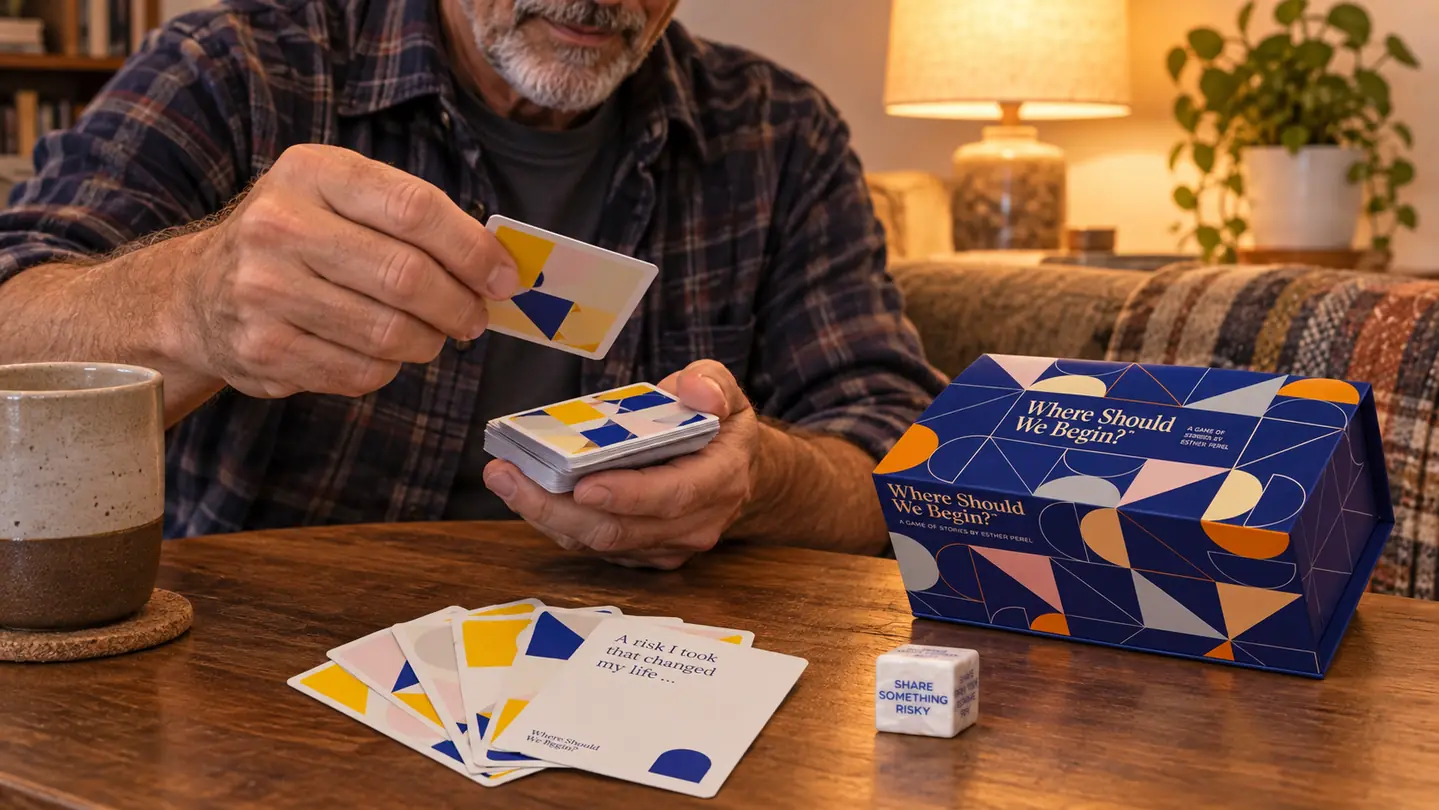
ESTHER PEREL Where Should We Begin? is a conversation card game, not a trivia quiz and not a couples workbook. The 2nd edition pack holds cards and dice, the cards are cardstock, and the pack measures roughly 6.6 by 3.5 by 4 inches, small enough to live on a shelf with the board games or ride along in a tote. The listing puts it at six players and ages 20 and up, and describes it for dating and game night. The theme on the box is storytelling, and that word does most of the work. This is a deck built to get a story out of somebody, not a yes or no out of them.
The BestSelf Relationship Deck is a deck of questions for couples, sorted into categories so you can choose the territory before you draw. There is no dice element, no group rule to work around, no scoring and no performance. You flip a card, you read it, you answer. It behaves more like a guided conversation than a game, and for a lot of couples that is precisely what makes it usable on a Tuesday.
How We Tested These at Our Table
We played on Thursday nights, after the kids went upstairs. Sometimes at the kitchen table, sometimes out on the back porch when the weather cooperated. Same rules every time: phones face down, no fixing each other's answers, no scoring. Paul is quieter than I am, so I watched for the moment he stopped giving me one line answers. That is the real test of a deck like this, not whether the cards feel nice in your hand.
Each deck got four Thursdays, and I deliberately did not run them back to back, so one would not color the other. Four weeks with the ESTHER PEREL game in late winter, four weeks with the BestSelf deck in early spring, with a couple of empty Thursdays between them as a buffer. I kept notes on the back of a grocery list pad, dated at the top of each page, along with the start and stop time. Deeply unscientific, but it made one pattern obvious fast: the two decks fail in completely different places, which is more useful to know than which one I personally liked.
First night with ESTHER PEREL Where Should We Begin? ran ninety minutes, which is a long Thursday for us. We started at 8:40 and I looked at the clock at 10:10 and neither of us had moved. First night with the BestSelf deck ran about twenty five minutes and ended with both of us still awake and pleasant, which counts for something when you are forty six and work mornings.
One more thing about the testing conditions. Paul is not a therapy guy and he would tell you so himself. He agreed to Thursdays because I asked, and because it beat the alternative, which was sitting in silence with the television on. That is the honest setting for this comparison. Not a couple in crisis, not a couple in a workshop. Just two tired people who wanted to like each other more by Friday.
The Part Nobody Warns You About
Both decks ask you to say something true out loud, and the cards are not the hard part. Paul and I have been married seventeen years. We are excellent at logistics and out of practice at everything else. The first time a card asked him something he had no rehearsed answer for, he laughed, looked at the ceiling, and took a long drink of coffee. That pause is the product. You are buying the pause.
The second thing nobody warns you about: a wide open prompt can shut a quiet person down. If the card asks you to describe a moment when you felt most yourself and your partner cannot find a moment within ten seconds, you get a short answer and the whole night deflates. A narrower question gets a better answer out of a person like Paul. Hold onto that, because it is the single biggest practical difference between these two decks.
What I tried first, and why it did not work: I started us on the wide open prompts, because those were the ones I personally found interesting. By the second Thursday Paul was giving me the ceiling look before I had finished reading the card. So I flipped the order and went to the shorter, more concrete cards first, warmed him up for fifteen or twenty minutes, then reached for the open ones once he was already talking. That one change did more for our Thursday nights than either deck did on its own.
Paul answered a card about the last time he felt proud of me before he finished his coffee, then kept talking for another hour. That is the entire case for this deck.
What Fell Flat
With the ESTHER PEREL deck, one card landed badly. Not because the question was unfair, but because it asked for a memory Paul genuinely could not retrieve, and the silence sat there a beat too long. I watched him turn the card over twice, as though the answer might be printed on the back. That is the risk of open prompts and it is baked in. The deck will not protect you from an awkward minute, and it does not pretend to.
With the BestSelf deck, the problem was the opposite. Some questions were so direct that the answer took one sentence and we were onto the next card before the answer had any room to breathe. One night we cleared eleven cards in under half an hour and I could not have told you afterward what any of them were about. Good for a fast check in, less good if you were hoping to end up somewhere you had not been before. Neither deck is delicate about any of this. Both have cons, and mine came from a table in Columbus, not a lab.

Where ESTHER PEREL Wins
Depth, first. The storytelling frame pulls longer answers out of people. I have played question decks where every card is answerable in one sentence and the night feels like filling out a form at the doctor's office. This one keeps opening doors. The dice help more than I expected, because they take the negotiation out of who goes first and which prompt gets read, and that small bit of chance keeps the mood light instead of clinical. The first time the die came up and handed Paul the opening question instead of me, he relaxed visibly, because the card had chosen him, not his wife.
Range, second. The listing says six players and it is sold for dating and game night, so it does not fall apart when another couple is on the porch or when the teenagers wander down for a snack. We played with friends in their forties on a Saturday and it held up fine, though I did quietly steer around two cards I would not read in front of company. The 2nd edition also brought new prompts and redesigned cards in a smaller box, so if you have only seen the first edition, this is not a straight reprint.
Where the BestSelf Relationship Deck Wins
Focus. It is built for two, and nothing about it needs adapting when it is just the two of you at the table. No dice to manage, no turn order, no group rule to bend. The categories mean you can pick the light stuff on a Tuesday and save the heavier territory for a weekend when nobody has to be up at five in the morning. On a night when one of us came home late and cranky, that structure saved the evening, because we could stay in the shallow end and still call it a Thursday.
The on ramp, though, is the real win. If your partner is the person who needs a specific question rather than an open field, this is the deck that gets you somewhere on a weeknight when nobody has ninety minutes. It is also the one I would hand to a couple who has never done anything like this and would feel ridiculous holding a die. Lower stakes, easier start, and sometimes that is what actually gets a quiet husband talking. The whole pack fits in a drawer beside the takeout menus, which is exactly where it ended up in our house.
The deck that kept my husband at the kitchen table for ninety minutes
ESTHER PEREL Where Should We Begin? is the one I would buy again. Cards, dice, a storytelling frame, and room for two people or a table of six. If your Thursday nights have gone quiet, start here.
Amazon Check Today's Price on Amazon →Who Should Buy Which
Buy ESTHER PEREL Where Should We Begin? if you want conversation with some momentum to it, if you like the idea of a game rather than a worksheet, if other people are sometimes in the room, or if the two of you have gotten so efficient at logistics that you need something to knock you off script. It is also the better pick for couples who are newly dating and want a deck with some play in it, and it is the one I would bring to a lake house weekend with two other couples.
Buy the BestSelf Relationship Deck if your partner freezes at big open questions, if ten or fifteen minutes is realistically all you have, or if you want a clear category structure so you can steer around a topic on a bad night. If you genuinely cannot decide, start with the narrower deck and work up. You can always add the bigger game later, and pairing a deck with a standing no phones night costs nothing but the evening.
And an honest note for the gift buyers. A deck is not a fix for a rough season. If things are genuinely bad, a card game will not carry that and it should not have to. But if the problem is smaller, if you have simply run out of new things to ask each other, a deck is a low effort way to restart a conversation you both already want to have and cannot seem to start on your own. I gave a copy to my sister and her husband for their anniversary, and I told them which deck to open first.
One deck, four Thursdays, and a husband who finally talked
The storytelling prompts did more for our table than any question list I have tried. Six players if you want a crowd, two if you do not. See the current price and the 2nd edition details on Amazon.
Amazon Check Today's Price on Amazon →