
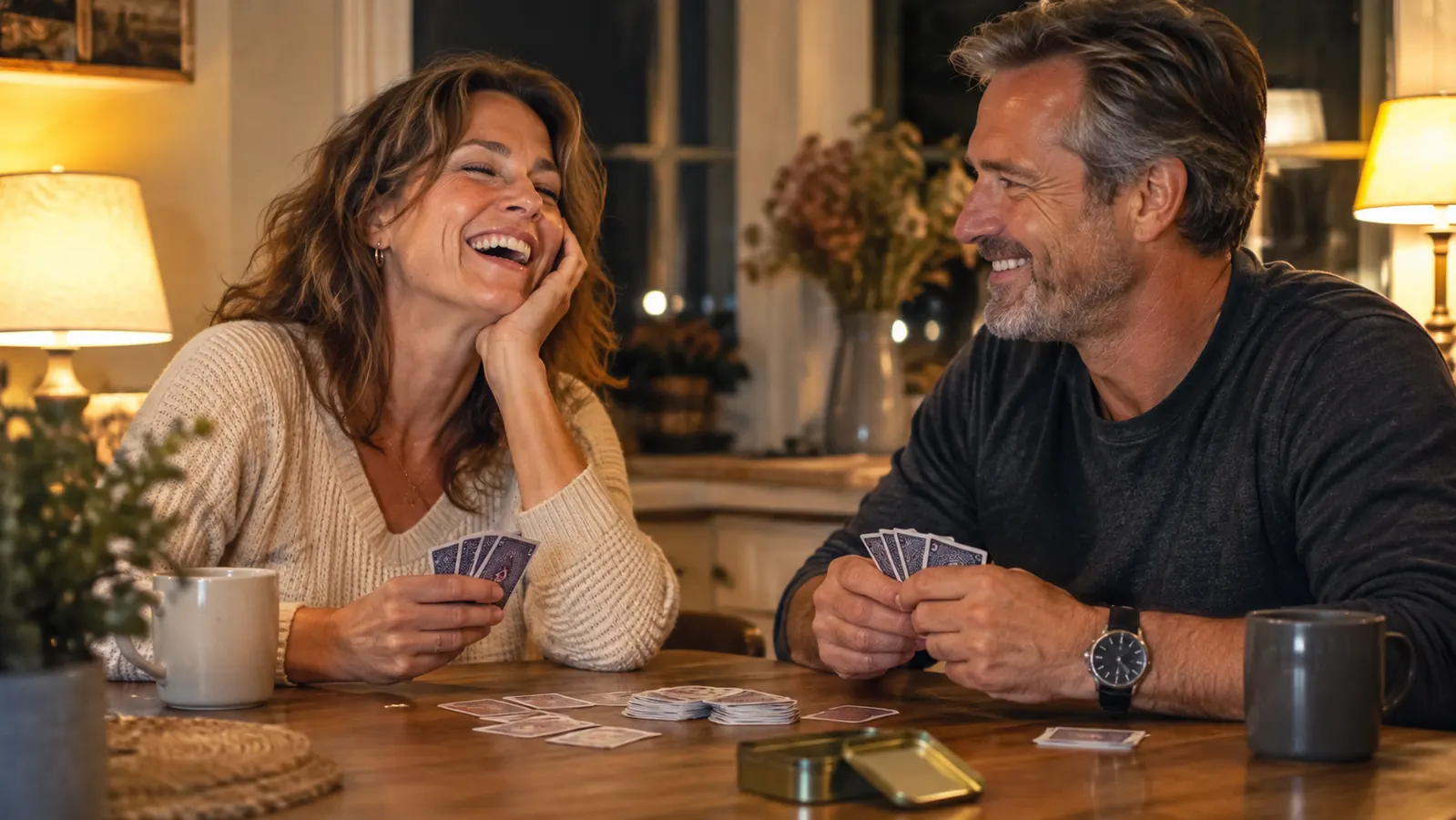
The kids are in bed and it is 8:40 on a Thursday. One of us is on the couch with a phone, the other is standing in the kitchen saying "what do you want to do," and the answer is "I don't know." That was us for a long stretch. Not fighting. Just parallel. Two people running separate evenings inside the same house. I am Renee, I am 46, I work as a middle school librarian in Columbus, and my husband Paul is 48 and fixes furnaces for a living. He is quieter than I am. After 17 years I noticed we could go three days without a real conversation that was not about a kid, a bill, or whose turn it was to run the dishwasher.
We tried the obvious fixes first. A movie is not a conversation, and a series is two people looking at the same screen. Then a friend sent us a small tin, The Couples Game from DSS Games, and I put it on the counter for a week before I opened it. I am glad I did, but not for the reason I expected. Dinner out is lovely once a month and impossible on a Thursday. And "just talking" failed the way it always fails: Paul asked how my day was, I said fine, and we both picked up our phones. That is not a character flaw. It is what happens when you hand two tired people an unshaped evening and expect chemistry to show up on its own.
One Tin, 150 Cards, and a Thursday That Didn't End in Silence
The Couples Game from DSS Games plays with two people, takes about a minute to learn, and needs no batteries, no app, and no screen. Three question categories, two dry erase boards, two pens, two cleanup cloths.
Amazon Check Today's Price on Amazon →Step 1: Pick the night before you pick the game
Most couples do not have a game night problem. They have a scheduling problem wearing a game night costume. You buy the box, you put it on the shelf, and every Friday one of you says "we should do that sometime," and then somebody has to work late and the whole thing quietly dies. I know, because we did that with three other things before we did this one right.
What worked was picking one night and treating it like a standing appointment neither of us gets to cancel. Ours is Thursday. It started because Thursday was the night neither of us had anything, which is another way of saying it was the night with the least competition, which is another way of saying nobody was going to protect it for us. Now it is the one night the phones stay in a bowl by the stove. Not because we are disciplined people. Because we decided once and stopped deciding every single week.
Two rules made it stick. First, the night survives bad moods. If one of us is fried, we still sit down, we just play shorter. Second, the night survives a bad week. We have missed Thursdays. We just never let two in a row go by, because two becomes four and four becomes a thing you used to do. A teenager who needs a ride at nine, a work trip, a head cold: all of it happens. Protect the rhythm, not any single evening.
Step 2: Give the evening a shape, not an open end
An open-ended evening is the enemy. "Whenever" means nine o'clock and a shrug. What fixed that for us was a shape: ninety minutes, roughly, from sitting down to lights out. Twenty minutes of catching up with no agenda. Fifty minutes of a game. Twenty minutes of whatever, and usually that whatever turns out to be the most honest conversation of the week.
The shape matters because it takes the pressure off. If you tell a quiet man, or a quiet woman, that tonight is going to be a deep meaningful conversation, you will get a polite hostage. If you tell them there is a game and it will take under an hour, they will show up. The conversation tends to arrive sideways, while you are laughing about something else. That took us about a decade to learn.
One more thing about timing: start earlier than feels natural. Eight is better than nine. By nine-thirty two people in their forties with jobs and teenagers are not at their best. We aim to be sitting down by eight-fifteen and we are almost always done before ten, which is a large part of why we are still doing it two years later.
Step 3: Pick a game built for two, not a party game with the guests subtracted
This is where most recommendations go wrong. People hear "couples game" and picture a trivia box that needs six people and a bottle of wine, or a deck of prompts so heavy that the first card turns a Thursday into a therapy appointment. I have tried both and both are bad for a weeknight.
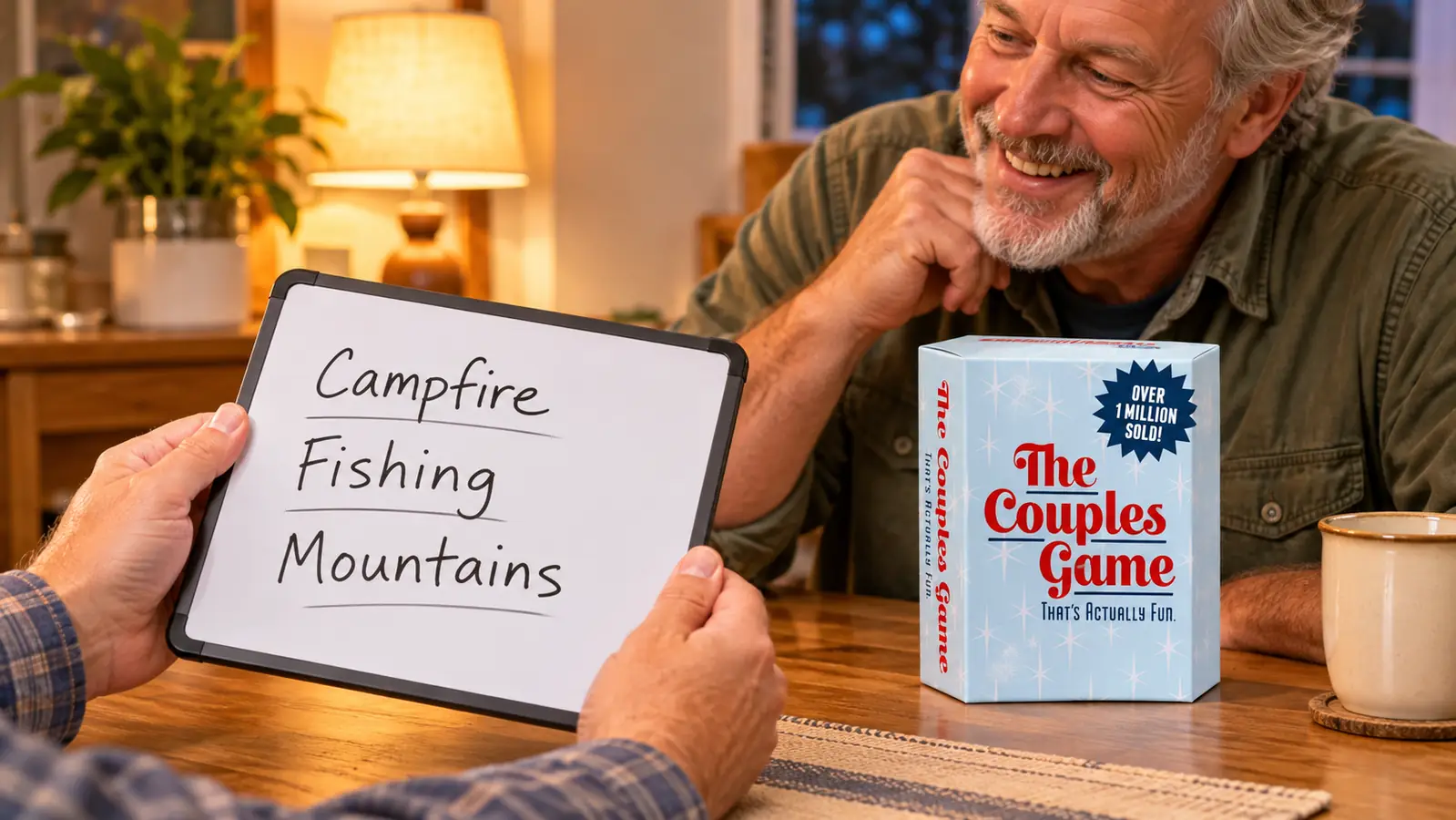
The Couples Game from DSS Games lands in the middle, which is why it is still on our table. It is 150 cards in three categories: Match, Best, and Me or You. Match asks you both to answer the same question and then compare. Best is ranking and picking. Me or You is a light argument about who is more likely to do something, and it produces more laughing in our house than anything else we own. The tin holds two dry erase boards, two pens, and two cleanup cloths, so anyone who needs to write an answer has somewhere to put it and nothing gets ruined.
What I like about it as a game rather than an exercise is that it gives the quieter person a specific thing to respond to. Paul does not have to invent a topic. He reads a card, he answers the card, and the answer usually opens a door we were not even standing in front of. The box says 14 and up and that is accurate. It is flirty in places and blunt in places and it is not explicit, which matters when a teenager wanders out for a glass of water.
The first Thursday we played, Paul answered a Match card and I learned something about him I had not known in 17 years of marriage. Not a huge thing. A small thing. Small things are what you stop collecting after a while.

Step 4: Set the table so nobody has to be the host
The physical setup does more work than you think. If one person has to hunt for pens and clear the mail and find a coaster, that person becomes the host, and the host is working while the other one is playing. So set it up before you sit down. Two chairs, the tin open in the middle, a drink each, and something to nibble that does not need a plate you have to wash.
Light matters more than decor. We turn off the overhead and leave one lamp on. That sounds precious and it is not. A bright kitchen at eight at night feels like a staff meeting, and a dim one feels like a place you would actually stay.
Phones go in a bowl. Not face down on the table. In a bowl, out of reach. The first three weeks this caused real grumbling. Now it is just what Thursday is. If you have a teenager who might need you, keep one phone on the counter with the ringer up and agree in advance that it is the emergency phone. That is the only exception we have ever needed.
Step 5: Stop while it is still good, then talk about nothing for ten minutes
The instinct is to play until you are tired. Do not. Stop while somebody is still laughing. We usually quit with cards left in the tin, and that is deliberate, because the last thing you remember about the night should not be a forced final round at 10:40 when you both have work in the morning.
Then put the tin away and sit for a few minutes. This is the part people skip. Some of the best conversations we have had in the last two years happened after the game was over, when the pressure was off and the boards were wiped clean. One of us will say "that one about the vacation, were you serious?" and then we are off. The game is not the point. The game is the thing that gets you to the point.
If it fell flat, say so out loud. We have had Thursdays where the category was wrong for the mood, or where one of us was too tired and answered everything with a joke. That is information, not failure. Next week you start with Me or You instead of Match and it goes better. Nobody is grading you.
What Else Helps
A few smaller things made our night better and none of them cost anything. Keep a short list of what worked and stop auditioning new games every week. Rotate two or three. Novelty is overrated and comfort is underrated. And do not schedule the night on a day that already has something in it. The whole thing collapses if it is the third item on a list.
Feed each other something easy. We do popcorn or cheese and crackers, and we eat it during the catching-up part rather than during the game, because a card game and a plate of food at the same table is how you end up wiping grease off a dry erase board.
If you have kids, treat the night as a thing they know about and are not invited to. Ours are 16 and 14 now and they have learned that Thursday after nine is not their window. When they were little we ran the same night on the back porch after bedtime and it worked just as well, only shorter and with more mosquito spray.
One honest caveat. A card deck is not a fix for a hard season. If money is tight, or somebody is grieving, or you are in the middle of an argument that keeps coming back, a game night will not touch it and pretending otherwise is dishonest. What it does is keep the door open, so that when the hard thing eases you are still two people who know how to sit at a table together. That is a smaller promise than most of the internet makes. It also happens to be the true one.
The Tin Lives on Our Counter Now, Not in a Closet
150 cards, three categories, two dry erase boards, two pens, two cloths. No batteries, no app, no screen. It plays with two people and it holds up with another couple at the table. If your Thursday has gone quiet, this is an easy way to find out whether it can come back.
Amazon See the Current Price on Amazon →