

Three years ago Paul and I started a Thursday night with no phones in the house. It was not a romantic gesture. We had become two people who talked about the water heater and the volleyball schedule and nothing else, and I wanted to stop that before it set like concrete. The first few Thursdays were rough. We sat on the back porch with nothing to say and it felt like a chore. A friend sent us the WE'RE NOT REALLY STRANGERS Couples Edition deck a few weeks into that experiment, and it has lived on our kitchen table, off and on, ever since.
Here is what nobody tells you before you buy a conversation deck: the good questions are not the deep ones. The deep ones you can see coming from a mile out. What catches you off guard is a small, strange, specific question you have never been asked in seventeen years of marriage, followed by the discovery that your husband has a completely different answer than the one you assumed he would give. That is the real value of this deck, and it comes from maybe ten cards out of the stack.
The Quick Verdict
A genuinely useful deck with about ten questions that stay with you for days. Buy it for a quiet weeknight, not to rescue anything.
Amazon Check Today's Price →The Deck That Finally Got My Quiet Husband Talking
Paul is not a talker. Seventeen years in, I have learned to ask narrow questions if I want a real answer. This deck asks them for me. If your house has a quiet one in it, this is the simplest way I know to get past the weather and the water heater.
Amazon Check Today's Price on Amazon →What Nobody Tells You Before You Open the Box
The first thing the product page does not spell out is that this is one deck, not a set of separate levels you can buy into one at a time. The cards run from light to heavy, and the light stretch is genuinely light. If you open the box expecting to be in a real conversation by card four, you will be disappointed. The first stretch is closer to small talk with training wheels, and you have to walk through it to get to the part that matters. Nobody mentions that. It is the single most common reason I think people put this deck down after one try and never pick it back up.
The second thing is the age rating. The WE'RE NOT REALLY STRANGERS box says 15 years and up, and that is about right, but not for the reason people assume. There is nothing explicit in here. It is that the questions toward the back assume a relationship with some history behind it. A couple who has been together six months will find those cards abstract. A couple who has been together sixteen years will find them pointed. The cards did not change between those two couples. The reader did.
Third, and this matters more than it sounds: it is a two-player game. Not two to six. Two. The listing says the number of players is 2 and it means it. There are other editions of this brand built for groups and for people who have just met, and if you bring this one to a dinner party it will not work. Someone ends up reading cards aloud while four other people watch, which is a different and much worse evening than the one you were picturing.
Fourth: the box is small and the whole deck weighs under a pound, so it travels well. That sounds like a footnote and it is not. Our copy has been to a rental cabin in Hocking Hills and to my sister's house over the holidays, and it came home both times. For a thing that lives in a drawer for eleven months of the year and then comes out on a Thursday, being portable matters more than any of the design details.
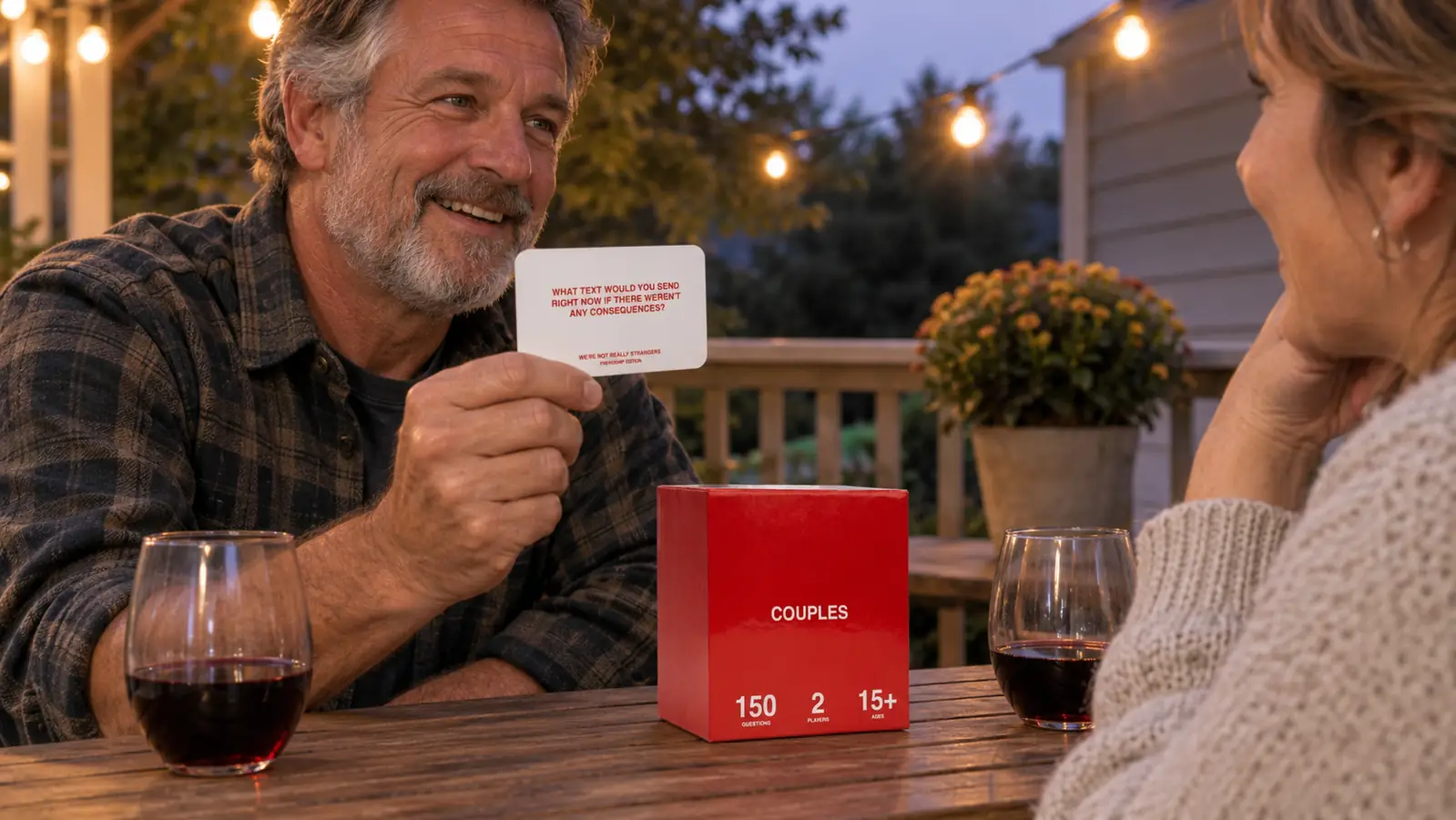
How Paul and I Actually Used It
Our window is narrow. The kids are sixteen and fourteen, and the house does not go quiet until about ten on a school night. So the testing happened at the kitchen table after they went to bed, usually with a pot of decaf going cold between us, sometimes on the back porch if the weather was decent. Paul is an HVAC technician and he is on his feet all day. He is also the quieter one. Left alone he will talk about a compressor for twenty minutes and then go silent, so a deck like the WE'RE NOT REALLY STRANGERS Couples Edition, which hands him one specific question instead of an open floor, is doing me a favor.
The first night we used it, we got through three cards and stopped. Not because it was heavy, but because the third card started a conversation that ran forty minutes past the point where the card was still relevant. We never went back to the deck that night. That has happened more than once since, and I have come to think of it as the deck working correctly rather than the deck failing at its job.
The other thing we learned is that the deck rewards being tired. Some of our best rounds happened on a Thursday when neither of us had the energy to be clever. When you are too tired to perform, you answer the question in front of you, and the answers come out plainer and more honest than anything you would say on a Saturday night with a glass of wine in you.
We also learned to stop at the card that lands. The temptation is to keep going, to finish the stack in front of you, to get your evening's worth out of it. That is the wrong instinct. The card that opens something needs room after it, and the room is where the conversation actually happens. We treat the deck as a starter now, not a full meal, and it works better that way.
The 15-Minute Playing Time Is Honest
The listing gives an estimated playing time of 15 minutes, and in our experience that is accurate. Fifteen minutes is one pass through a small handful of cards, and it is the right length for a weeknight when one of you has to be up at five. It is also, if I am being straight with you, close to the limit of what most couples can do in one sitting before the conversation needs to go somewhere with the door closed.
The flip side is that it will not fill an evening. If you are picturing something long and candlelit and hours in the making, this is not that. We have used it as a warm-up before watching something, and we have used it as the whole event, and the whole-event version felt short. Fifteen minutes is fifteen minutes, and no amount of atmosphere changes the arithmetic.
That said, working all the way through the deck takes weeks, because it runs further than you expect. We are still not through the last stretch, and we have owned this thing for a while now. The 15-minute number describes a single sitting, not the deck. The deck has a much longer runway than the box suggests, and the runway is where the good stuff lives.
What Surprised Me Most
I expected the deck to be a shortcut to the kind of conversation you have at a wedding after two drinks, where everyone says something sincere and then it is over and everyone goes back to the buffet. It is not that. What surprised me is how much of it turned out to be about memory. Several of the best cards ask you to describe something you both lived through, and the two versions never match. Not in a bad way. Just in a way that makes you realize you have been carrying a slightly different marriage around in your head than your husband has, for years, without either of you noticing.
The second surprise is that it is not really a talking skill. Paul has always been better at talking about problems than about himself, and there is a difference. A card that asks him about a problem gets a solution-shaped answer and the conversation dies on the vine. A card that asks him about a person, or a year, or a thing he wanted when he was twenty-five, and he will go for twenty minutes. This deck is mostly the second kind of question. That is why it works on him and why most of my own attempts over the years did not.
The third surprise is that it did not fix anything, and I want to be clear about that, because the marketing around conversation decks can get lofty. It did not stop us from arguing about the dishwasher. It did give us a shared vocabulary for a couple of things we had been circling for years, and that has been quietly useful in ways I did not expect six months later. If you are expecting more than that from a box of cards, you will be let down by any box of cards.
The Cards That Landed, and the Ones That Did Not
I am not going to list the actual questions, because the whole point is that you do not see them coming. What I will say is that the cards that landed hardest for us were not the ones about the future or about feelings. They were the ones about the past. One card asked us to describe the other person from a specific earlier point in the relationship, and Paul's answer was so detailed and so unlike the way I remember that stretch that I sat with it for two days afterward.
The other category that worked was the small apologies. There is a stretch of the deck that invites you to say something you have been carrying around, and it turns out I had been carrying something around for about four years without ever labeling it as a thing I was carrying. That conversation took maybe eleven minutes and it did more for us than the last three date nights combined. I did not see it coming from the card before it, and I do not think I would have brought it up on my own.
The cards that did not land were the early ones. Some of them read like a getting-to-know-you worksheet from a church basement. Paul and I both answered in four seconds flat and then looked at each other over the decaf. That is the warm-up doing its job, in theory. In practice it means the first ten minutes of any session can feel like homework, and if you quit during the warm-up you would be forgiven for deciding the whole deck is corny.
The cards that landed were not the deep ones. They were the small ones about a year I had been remembering wrong for a decade.

The Practical Stuff Nobody Mentions
The WE'RE NOT REALLY STRANGERS cards are cardstock and the deck weighs about 0.38 kilograms, which is light enough to toss in a tote bag with a book. They are not laminated. A spilled mug will do permanent damage to whatever card it reaches, and I know this because a mug went over on ours in January. We lost two cards and the deck still runs fine, because it runs long enough that losing two does not break anything. That is either a design decision or luck, and either way I will take it.
The language is English only. That is worth flagging if you are buying this as a gift for a couple where one partner is more comfortable reading in a different language. It is not a flaw, but the listing buries it, and this is exactly the kind of gift people buy in a hurry without checking anything except the rating.
And the 15-and-up rating is not a suggestion. There is nothing explicit in the box, but the back half of the deck assumes a level of relationship experience that a fifteen-year-old in most cases simply does not have. If you are buying for a teenage couple, buy something else. If you are buying it for your own teenagers as a joke gift, they will not find it funny, and you will have spent money to be told so.
Where It Fell Flat
There were cards that made me roll my eyes. A few of the middle ones are written in a voice that assumes a certain amount of emotional fluency, and if your partner is not that kind of talker the phrasing can land as precious. Paul's response to one of them was to ask what it even meant. He was not wrong, that card is still in the deck, and I still skip it.
The bigger issue is repetition. Once you have been through a stretch of the deck, you know the questions. The second pass is not the first pass, not even close. We started skipping cards we had already done, which is fine, but it does mean the deck has a shelf life if you use it weekly. Ours comes out every few months now rather than every Thursday, and I do not think that is a failure. It is just what happens with any fixed set of prompts.
The last thing, and this is the one I would want a friend to tell me before I bought it: it does not work if your partner is not willing. A deck in front of a person who has already said they do not want to do this kind of thing is worse than no deck at all. We had a night like that early on, where Paul answered three cards in monosyllables and I got quietly annoyed about it for two days. That was not the deck's fault and it was not really his. It was a Thursday where the timing was wrong. We tried again two weeks later and it was fine, which is the whole lesson.
What I Liked
- About ten questions that do real work and stay with you for days
- 15-minute sessions fit a weeknight without a sitter or a plan
- Survives travel and being stuffed back in a drawer
- Gives a quiet partner a narrow prompt instead of an open floor
- Two-player format means no audience and no performance
Where It Falls Short
- The first stretch is filler and will lose some couples before the good cards
- Fixed prompts get familiar, so it has a shelf life at weekly use
- Strictly two players, so no group play at all
- A handful of cards are written in a tone some people will find precious
- Not laminated, so one spilled drink can end a card
Who This Is For
This deck is for a couple with some mileage on the relationship who have slipped into logistics. You know the pattern. The whole week is schedules and errands and who is picking up which kid, and by Friday night you have not said anything to each other that was not a task. That couple will get real value out of this, particularly if one partner is quieter than the other and needs a narrow question to get moving. It is the closest thing I have found to handing your husband a script he did not know he wanted.
It is also a solid gift for an engaged couple, provided you know them well enough to know they will actually open it. The WE'RE NOT REALLY STRANGERS Couples Edition is a good engagement gift for exactly that reason and a bad one for the opposite reason: a deck in a drawer is a deck in a drawer. If you are the kind of person who gives a gift and then asks about it later, make sure the couple is the kind that will have an answer for you.
Who Should Skip It
Skip it if your relationship is in real trouble. This is a card game made of cardstock with an estimated playing time of a quarter of an hour. There is a version of this purchase where a couple buys a deck hoping it will do work that a licensed counselor should be doing, and that version ends with a deck in a drawer and a harder conversation six months later. I would not put that on a box, and neither should anyone else.
Skip it if you want a group game, if you want something that fills a whole evening, or if you are buying for a couple who have been together less than a year and are still in the easy stage where conversation comes free. And skip it if your partner has told you plainly that they are not interested in this kind of thing. A deck is a poor argument, and it is an expensive way to lose one.
If a Quiet Thursday Is the Only Night You Get, This Is the Deck I Would Hand You
Two players, fifteen minutes, no setup and no scorekeeping. If you have been meaning to have a real conversation and keep pushing it to the weekend that never arrives, take one Thursday and start with three cards. That is the whole method.
Amazon Check Today's Price on Amazon →