
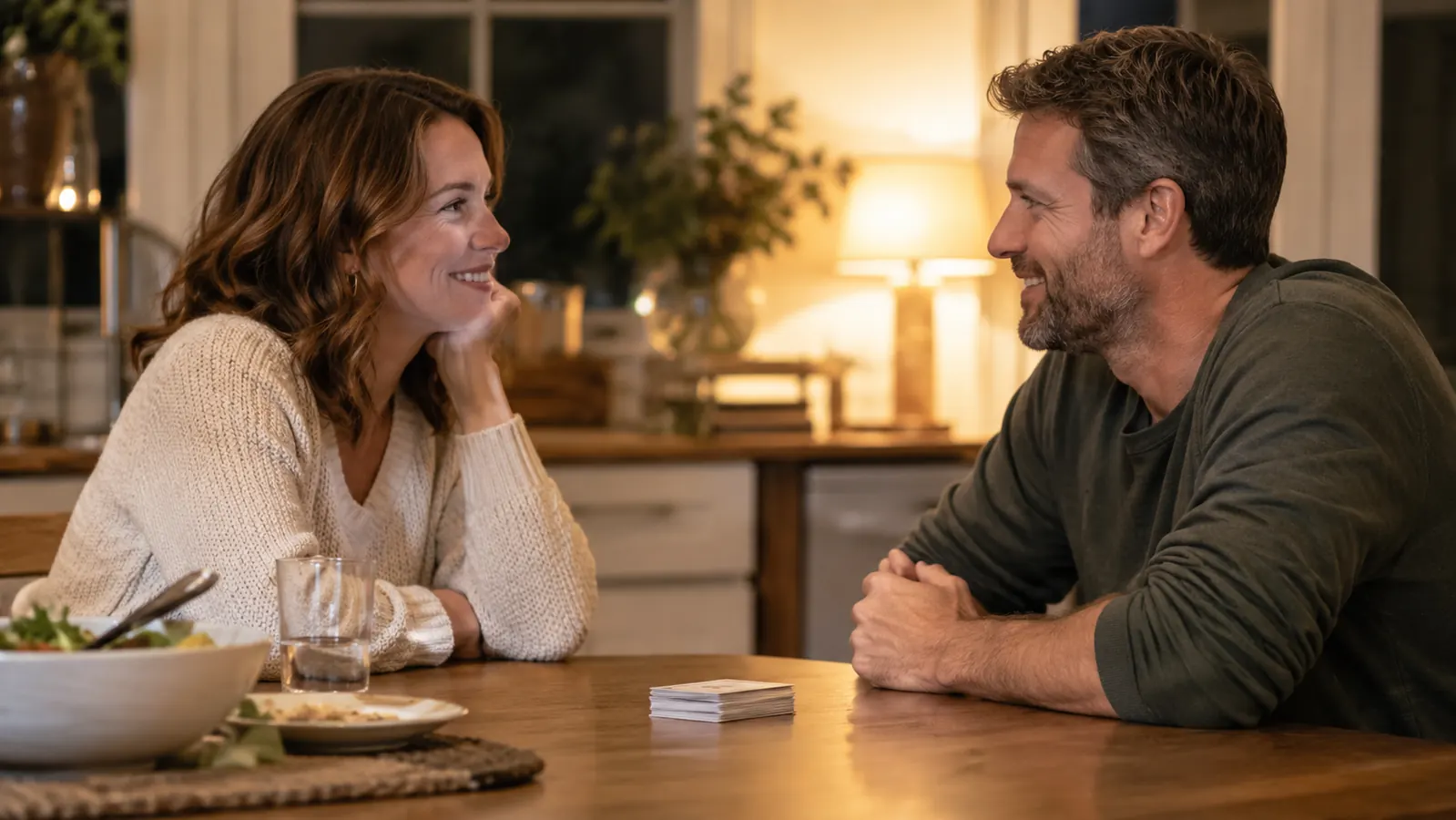
Paul and I have a Thursday rule. Phones go in a drawer, the kids go upstairs, and the two of us sit at the kitchen table with nothing to look at but each other. For a while that meant a board game. Then it meant the same room and two different screens, which is worse than it sounds and much harder to notice while it is happening. The deck that got us talking again was the WE'RE NOT REALLY STRANGERS Couples Edition. A friend later handed us {THE AND} Long Term Couples with the warning that it gets real. Both are good. They are not interchangeable, and that is the entire reason this comparison exists.
Here is the short version. If you want a fifteen minute game you can pull out on a random Tuesday, one that mixes silly with sincere and works whether you have been together two years or twenty, the WE'RE NOT REALLY STRANGERS Couples Edition is the one I reach for. If you are years into a long relationship and you want a deck that pushes past the polite version of your marriage, {THE AND} Long Term Couples goes further and asks more of you. Most couples I know need the first one far more often than the second, and the couples who need the second one usually already know it.
Side by Side
| WE'RE NOT REALLY STRANGERS Couples Edition | {THE AND} Long Term Couples | |
|---|---|---|
| Session length | 15 minutes estimated playing time, easy to fit after the kids are down | Built for a long sitting, an hour or more |
| How deep it goes | Warm and playful, with a few cards that catch you off guard | Deliberately heavy, written for couples years into the relationship |
| Tone | Mixes funny with sincere, so it never feels like an assignment | Sincere from the first card, with almost no levity |
| Who it is built for | Any stage of a relationship, listed as a game night for two | Couples who are already established and settled |
| Age range | Listed for 15 years and up | Written for adults |
| What is in the box | A deck of cards on cardstock, 0.38 kg | A boxed deck of prompt cards |
| Hard conversations | Keeps the night light, which is the point of a game | Will surface things you have both been avoiding |
How We Tested These Two Decks
I am not a therapist and I am not going to pretend a card game is one. What I am is a 46 year old school librarian in Columbus, Ohio, married to the same HVAC technician for 17 years, with two teenagers in the house and a standing Thursday night where the phones go in a drawer. That is the lab. A kitchen table, a small back porch, and the hour after the kids go to bed. Nothing in this comparison was tested in a focus group or a conference room.
We played the WE'RE NOT REALLY STRANGERS Couples Edition in short rounds across several months, usually on a weeknight, usually with the dishes still out. We played {THE AND} Long Term Couples twice, once on a Sunday afternoon and once on the porch after dark, because it is not a deck that fits into a Tuesday. I took notes on the back of a grocery list. Everything below comes from those nights and not from the listing copy, which is why some of it is less flattering than the packaging.
What Each Deck Actually Is
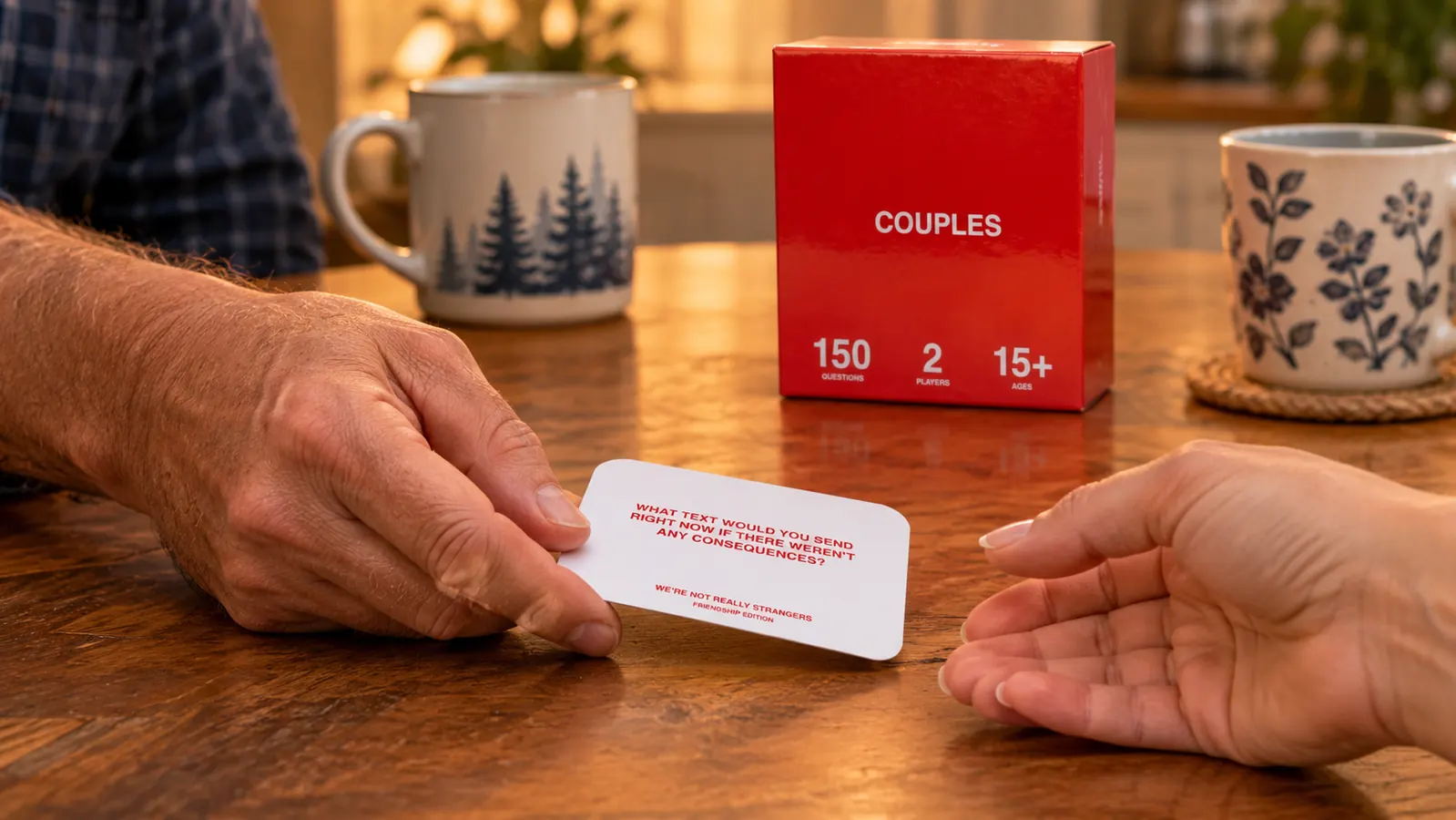
The WE'RE NOT REALLY STRANGERS Couples Edition is a two player card game. It is a deck of cards on cardstock, listed for 15 years and up, with an estimated playing time of 15 minutes and an item weight around 0.38 kg. That is the whole kit. No board, no timer, no app, no scoring, nothing to charge. You shuffle, you deal, you read a card out loud, and the other person answers. It carries a 4.6 star average across roughly 2,800 ratings, which for a conversation deck is unusually high and suggests most people finish a round feeling better than when they started.
{THE AND} Long Term Couples comes from The Skin Deep and it is a different animal. The prompts are longer. They assume shared history, and they do not waste the first ten cards on easy warm ups. The deck is built for a sitting rather than a quick round. Where the WE'RE NOT REALLY STRANGERS deck asks a question and then moves on, this one tends to sit in the answer for a while and see what else floats up to the surface.
The practical difference is pacing. One deck is designed to be finished, and finishing feels good in a way that matters more than it sounds. The other is designed to be lingered in, and lingering is where the harder material lives. If you have ever abandoned a real conversation because someone's phone buzzed, you already know why this distinction carries more weight than the questions themselves. Content is only half of it. The other half is whether the two of you stay in the chair.
Where WE'RE NOT REALLY STRANGERS Wins
It fits a real weeknight. Fifteen minutes is the listed playing time and in practice that is about right for a round. Paul and I can get through a handful of cards between the dishes and the ten o'clock news, and stopping halfway through the deck is not a failure. A game you can actually finish is a game you will actually play, and that single fact does more for a relationship than any prompt ever written. The best conversation deck is the one that gets opened.
It also keeps the tone human. Some cards are goofy. Some are not. The mix means you are never quite sure what you are walking into, which is what stops the deck from feeling like a therapy assignment in a nice box. The listing calls it a game night for two at any stage of a relationship, and that holds up in practice. I have played it with couples who were dating for eight months and couples marking a twentieth anniversary, and nobody had to be talked into drawing the next card. That range is harder to pull off than it looks.
Where {THE AND} Wins
It goes deeper, and it does not apologize for it. The prompts in {THE AND} Long Term Couples assume years of shared context and then ask about the parts of that context most couples route around: the resentment that never got said out loud, the version of yourself you were before the mortgage, the thing you have both quietly agreed not to bring up at dinner. A deck willing to ask those questions is worth having on a shelf, even if the shelf is where it spends most of the year.
The second thing it does better is slow you down. There is no score, no round, no natural exit. You sit with an answer. For a couple that has gotten very good at efficient conversation, the inefficiency is the medicine. Paul is the quieter one in our house, and the longer format is the only thing that has ever gotten more than four sentences out of him on a Thursday. Fifteen minute games do not do that. Long silences with a card on the table do.
The One I'd Hand a Couple on Their Second Date and Their Twentieth
Two players, 15 minutes, 4.6 stars from about 2,800 ratings, and a deck that does not ask for an evening you do not have. If you want the game more than the homework, start here.
Amazon Check Today's Price on Amazon →
What Happened at Our Table
The first time we played, I expected Paul to hate it. He is an HVAC technician who spends all day solving problems and most of the evening not talking about them. We got about six cards in before he answered something with an actual feeling in it. I am not going to pretend a card deck changed our marriage. What it did was give him a doorway, and a doorway is not nothing when you have spent two years discussing only schedules and receipts.
With {THE AND}, the night was heavier. We played on a Sunday, on the back porch, with the specific intention of not rushing it. Two prompts landed badly and one turned into an hour long conversation we probably needed to have three years ago. We have not played it since and I mean that as a compliment. It is not a weekly deck. It is a deck you take down when you have something to talk about and the time to actually do it.
That is the honest split. One deck is part of the furniture. The other is an event. Most marriages need more furniture than events, which is why my recommendation is not a tie and why I am not going to pretend it is one just to seem even handed.
Six cards in, my quiet husband answered something with an actual feeling in it. Fifteen minutes, two players, and a doorway. That is the whole review.
The Tradeoffs Nobody Mentions
Neither deck fixes a couple who cannot be in the same room. If the real issue is contempt or a genuine crisis, a stack of cards is a very small tool, and it would be dishonest to suggest otherwise. That is true of every product in this category. Anyone who tells you a game night repairs a marriage on its own is selling something, and it is probably not the deck.
The WE'RE NOT REALLY STRANGERS deck has a ceiling. After a dozen plays you start to recognize the cards. Not all of them, but enough that the surprise wears off and the answers get shorter. It is a deck to own for a year, not a decade. I would rather say that than pretend otherwise, because a deck that oversells itself is a deck that ends up in a drawer with the half finished puzzles.
{THE AND} has the opposite problem. It is heavy enough that the barrier to pulling it out is high. You have to be in the right mood, you have to have the time, and you have to be willing to not control where the conversation goes. Decks that ask for that much tend to sit. A shelf is not a failure, but a shelf is a shelf, and an honest review has to leave it there.
The Case for Owning Both
Plenty of couples end up with both, and I understand why. The WE'RE NOT REALLY STRANGERS deck covers the ordinary weeks. {THE AND} covers the weekends where nobody has anywhere to be. They occupy different slots in the same cabinet and they do not compete for the same fifteen minutes. If you have the shelf space and you like the idea of a light option and a heavy one, this is not an either or decision in any real sense.
If you are going to buy them one at a time, buy the game first. A couple who owns a heavy deck and no light one tends to have a heavy deck in a drawer. A couple who owns the light one first builds the habit of sitting down on purpose, and a habit is the thing that makes the heavier deck usable later. Order matters here more than most reviews admit.
How to Play Either One Without It Feeling Like Homework
Set a container. For the WE'RE NOT REALLY STRANGERS deck that is one round, roughly fifteen minutes. For {THE AND} it is an evening with a hard stop, because the hard stop is what makes it safe to go somewhere uncomfortable. Knowing when the conversation ends is what lets you start it.
Answer first. Whoever draws the card should go first, even when the card is aimed at the other person. It levels the room. Paul and I do this now and it is the difference between a conversation and an interrogation, which is a line that is much easier to cross than people expect when one person is holding all the questions.
Skip cards. This is the part nobody says out loud. Both decks contain prompts that will land wrong on a given night. You are allowed to put the card back in the box and move on. A conversation deck is a tool, not a test, and treating it like a test is exactly how you get a couple who never plays a second round.
Who Should Buy Which
Buy the WE'RE NOT REALLY STRANGERS Couples Edition if you want a game. That means short sessions, a lighter tone, exactly two players, a deck that works whether you have been together a year or two decades, and a set you can leave on the shelf without it staring back at you. It is also the easier gift, since the 15 and up age range and the fifteen minute format make it simple to hand to almost anyone, including the couple who insists they are not the type for this sort of thing.
Buy {THE AND} Long Term Couples if you have years behind you and you want to talk about them. It is the better choice for an anniversary weekend, a long stretch with no kids in the house, or a couple who has already done the light stuff and found it wanting. It is not the deck I would hand to a couple who just moved in together, and I do not think it is trying to be. It assumes you have a shared history worth interrogating.
If You Only Buy One, Buy the One You'll Actually Play
Two players, 15 minutes, 4.6 stars from about 2,800 ratings, and a deck that fits between the dishes and the news. The heavier one can wait for the weekend.
Amazon Check Today's Price on Amazon →