
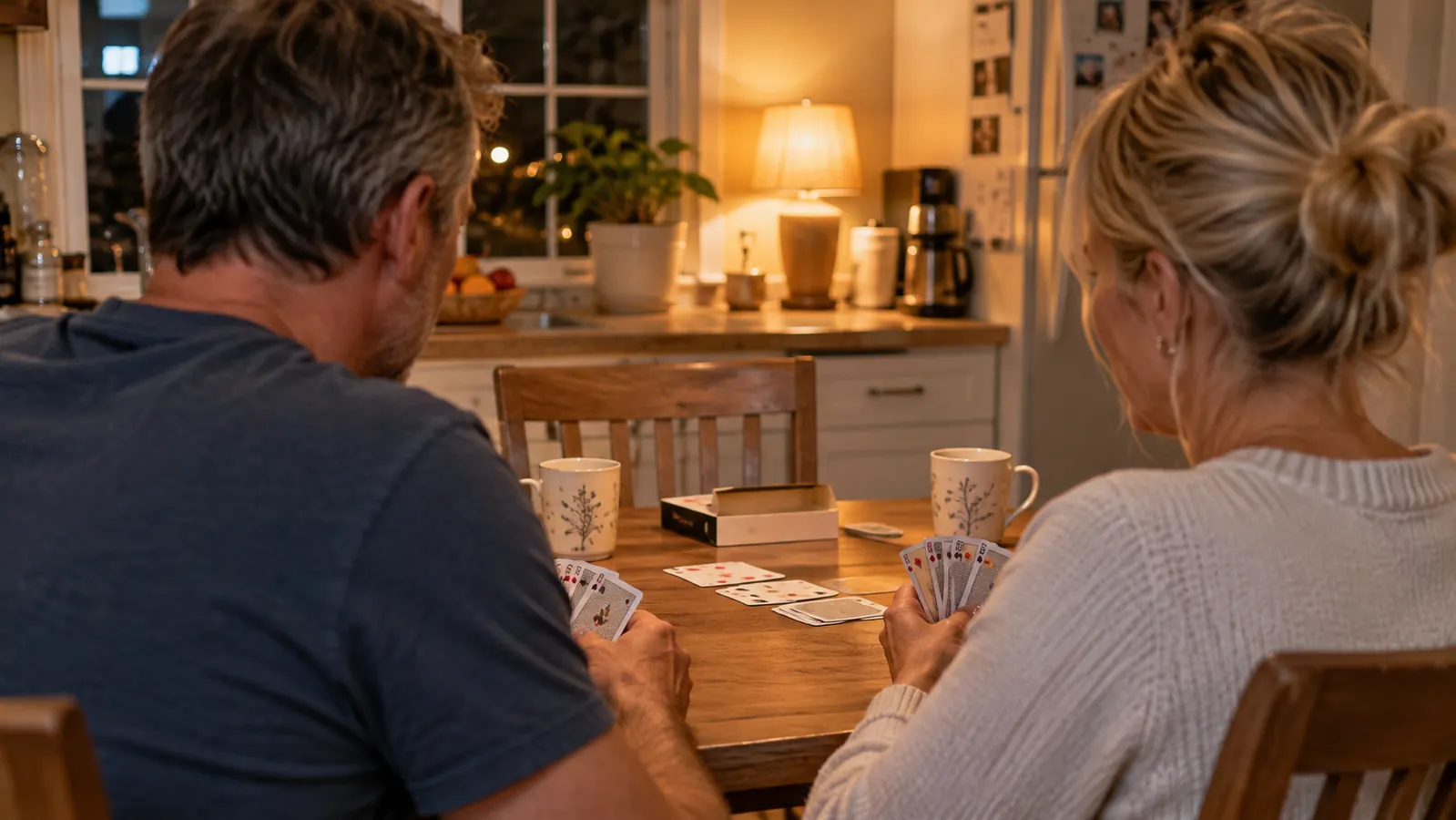
The box sat unopened on our kitchen table for eleven days. I want to be upfront about that, because the reviews of the ESTHER PEREL Where Should We Begin? card game I read before I bought it all made it sound like something you tear into the same night it arrives. I did not. Paul walked past it four or five times, asked what it was, and then found something to fix in the garage. That reaction is the whole review in miniature, and it is the part nobody puts in the product listing.
So here is the honest version. I am Renee. I am 46, I work as a middle school librarian in Columbus, and I have been married to Paul for 17 years. He is an HVAC technician, he is quieter than I am, and he is the person in this house who needs a reason to talk. I have bought a lot of things that were supposed to help with that. Most of them live in a drawer now. This deck is not in the drawer, but it is also not the thing the marketing says it is, so let me sort that out.
The Quick Verdict
A genuinely good deck for a partner who needs a doorway into conversation. It is not a weeknight pickup game, and the first round will feel strange.
Amazon Check Today's Price →If Your Husband Answers Fine to Every Question, Start Here
The deck does the asking so you do not have to. Two people, one hour, phones in the other room. Ours has earned its spot by the door.
Amazon Check Today's Price on Amazon →What is in the box is modest. A pack of cards, a set of dice, and a box about the size of a paperback, 6.6 inches long, 3.5 inches wide, 4 inches tall. That is the 2nd edition, which arrived with redesigned cards and a smaller box than the first run. The size matters more than it sounds like it should. It fits in a tote bag or the zippered pouch of a suitcase, which means it can leave your kitchen. A deck that stays on the shelf becomes furniture.
How We Actually Played It
The first time we played was a Thursday, which is our no-phones night. That tradition started about three years ago, back when we could go whole evenings without saying anything that was not logistics. We had gotten good at running a household together and bad at being interested in each other. The deck landed in the middle of that, and here is what happened. Paul read the first card, made a face, and said, 'This is going to be weird.' Then he answered it anyway.
That is the thing about a structured prompt. It gives a person permission to say something they would never volunteer. Paul is not going to sit on the porch and announce a memory from 1994. He will answer a question that is printed on a card in front of him, because now it is a task, and Paul is very good at tasks. I have stopped trying to turn him into a man who opens up over dinner and started meeting him where he is, which is a man who will open up if you hand him an assignment.
The cards move in a rough arc, lighter at the beginning and heavier later. You can feel it happen. Ten minutes in, you are telling a story about your first job. Forty minutes in, someone has said something about their father that they have not said out loud in a decade. That escalation is the design and it works. It is also why this is not a party game, no matter what the product title suggests.
Our first session ran about ninety minutes, longer than I expected. We did not finish the deck. We stopped at a card neither of us wanted to answer, and we both knew it at the same moment, and we put the cards away and went to bed talking about something else entirely. That is not a failure state. A deck you do not finish is a deck you can come back to.

What Nobody Tells You About the First Ten Minutes
The opening is the hardest part and almost nobody mentions it. There is a stiffness to the first round that has nothing to do with the cards and everything to do with two people who have been married for nearly two decades suddenly performing the act of having a conversation. You feel silly. One of you will make a joke about how this is like being on a first date. Let it happen. By the third card the performance drops away, and that shift is real, but you have to be willing to sit through the awkward entrance to get to the room.
The other thing nobody mentions is that it does not work as background. This is not a deck you can half-attend. Paul tried to answer a card while also watching the last five minutes of a basketball game and it went nowhere, which is not the deck's fault. Put the phones in the other room. Our Thursday rule already does that for us, and I suspect that without it we would have gotten a lot less out of the deck.
He is not going to sit on the porch and announce a memory from 1994. He will answer a question printed on a card, because now it is a task.
The Part That Fell Flat
Not every card lands. Some of the prompts about early romance ask you to reconstruct a version of yourself you barely remember, and I found myself giving a summary instead of an answer. Others are so broad that Paul, who thinks in concrete terms, would shrug and say, 'I do not know, what do you want me to say?' A prompt that asks for an abstraction invites a shrug. I started skipping those and I do not feel bad about it.
There is also a limit to how many times you can play it. We went hard at it for about six weeks, twice a week, and then we set it down for a month and did not miss it. When we came back, we had forgotten which cards we had drawn and it worked again. But if you are imagining a nightly ritual, you will burn through the novelty faster than you expect. This is a deck you cycle, not one you live inside.
And the game night framing in the product title is generous. The box says up to six players and I believe that for one specific kind of group, but you are not pulling this out at a Super Bowl party. The couple friends we did try it with were willing, and the evening was fine, but the questions turn personal quickly and a group turns personal into performative. Two people is the real number.
What It Does That a Porch Conversation Does Not
Paul and I talk on the back porch most evenings in the warmer months. That is not nothing and I would defend it against any card deck. But porch talk drifts. It lands on the kids, on work, on whether we need to reseal the deck itself. The deck forces a direction. It is the difference between how was your day and what would you do differently if you got to start over at thirty. We are not going to arrive at the second question on our own. We need a piece of cardstock to get us there, and I have made peace with that.
What surprised me is what carries over. In the days after a session, Paul would bring something up at dinner unprompted, an echo of whatever card he had answered the night before. The deck opens a door and then the two of you can walk through it again later without the deck. That is worth more than the awkward entrance. It is the reason I stopped thinking of this as a novelty purchase.
A Word From Paul, Who Did Not Want to Play
I asked Paul what he would say about it, since a review written only by the talker in the house is missing half the story. He thought for a minute and said, 'It is better than I expected, and I still do not want to do it every week.' Then he added the part I think is the real endorsement. He likes that there are instructions. When I ask him questions out of nowhere it feels like a test, he said. When a card asks him, it feels like a game. Same question, different frame, completely different response.
He also flagged something I had not noticed. The cards make it easier to say no. If a prompt is too much, you can put it down and move on and nobody's feelings are hurt, whereas if I ask him something heavy at the wrong moment and he deflects, we are halfway to an argument. The deck gives both people an out. That is a design detail I would have missed on my own, and it matters most in couples where one person is more private than the other.

The Reviews Get the Feeling Right and the Fit Wrong
The deck sits around 4.5 stars across several hundred reviews, and reading through them is instructive. The five-star reviews describe exactly what I described. A quiet partner who finally talked. A discovery after years together. A night that felt different. The one- and two-star reviews are mostly from people who expected a party game, or tried it too early in a relationship, or played with a group and got an evening they did not want. Both camps are describing the same product accurately.
The gap is fit, not quality. A deck that asks you to be vulnerable with someone you have known for a decade is doing one job. A deck that asks you to be vulnerable with someone you have been dating for a month is doing a different job, and the second job asks too much too soon for a lot of people. The box says 20 and up. I would add my own guidance: a few years together, minimum, and both people actually willing.
How It Compares to the Other Decks in the Hall Closet
We have three of these now. The other two are the sort that ask you to rate your week on a scale and name your favorite memory, and they are pleasant in a greeting-card way. What separates the ESTHER PEREL deck is the second half. The others stay in the shallow end for the entire evening, which is fine and nobody gets uncomfortable, but nothing gets said that you will still be thinking about on Sunday. This one goes somewhere.
The tradeoff is that going somewhere has a cost. The lighter decks we can play with the kids in the room, or with another couple, or when one of us is tired and half-checked out. The ESTHER PEREL deck asks for a real hour, both people, phones elsewhere, no audience. If that is not what your evening looks like, one of the lighter decks is a better match and that is not a failure. It is a match problem, not a quality problem.
The Physical Thing Itself
The cards are cardstock, sturdy enough that ours still look new after a year of Thursday nights and one trip to a rental cabin. The 2nd edition box is smaller than the original, which sounds like a packaging footnote and is not. Ours lives in the tote bag by the door, and it comes out more often because of that. Small boxes get used. Big boxes get shelved.
What I Liked
- Gets a reluctant partner talking without turning it into a confrontation
- Prompts escalate gradually, so the heavy questions arrive after some trust is built
- The small 2nd edition box travels, which means it actually leaves the shelf
- Sturdy cardstock that has held up through a year of regular use
Where It Falls Short
- The first ten minutes are stiff and there is no way around it
- Some prompts are too abstract and invite a shrug
- The game night framing oversells it as a group activity
- You will burn through the novelty in about six weeks and need a break
Who This Is For
This is for the couple where one person is a talker and the other is not, and the talker has been quietly carrying the conversation for years. That is us. If you are the one reading this review, you are probably the talker. The deck does the asking so you do not have to, and that takes weight off both of you. It is also good for a couple in a rut that is not a crisis. Roommates with a shared mortgage, no fighting, no spark. That is a real thing and this deck addresses it kindly.
It suits a couple that travels. Small box, no setup, no screen, works in a hotel room or a cabin. We took ours to a rental near Hocking Hills in the fall and played two nights, and those were the best two conversations of the trip. It is fine for a couple that is dating steadily and both people are comfortable going deep. It is fine for a couple married thirty years who think they have heard everything.
Who Should Skip It
Skip it if the trust is not there yet. A card that asks about your childhood can land badly with someone you have known for six weeks, and there is no version of this where that is a good idea. Skip it if one of you is going to treat the whole thing as a joke, because that person will pull the other one down with them and the evening will end worse than it started. Skip it if you want a party game. This is not that, whatever the title says.
And skip it if you are looking for a fix. A deck of cards does not repair anything. What it does is create an hour where two people who have fallen out of the habit of being curious about each other have a reason to be. If the habit is gone for a serious reason, an argument that never got resolved, a year of resentment, a thing one of you will not talk about, this deck will not touch it. It is a doorway. It is not a repair crew.
The Deck Will Not Fix Anything. It Will Get You Talking Again.
Ours has been by the door for a year and it still comes out about once a month. If you are the one who carries the conversation in your house, this hands some of that weight to a stack of cardstock.
Amazon Check Today's Price on Amazon →